Observability isn’t an add-on: it’s the orchestrator.
Every hand-off, every tool call, every score: captured by default. We don’t bolt observability on after the fact; we make it the rail every agent walks on.
Platform team
Platform engineering
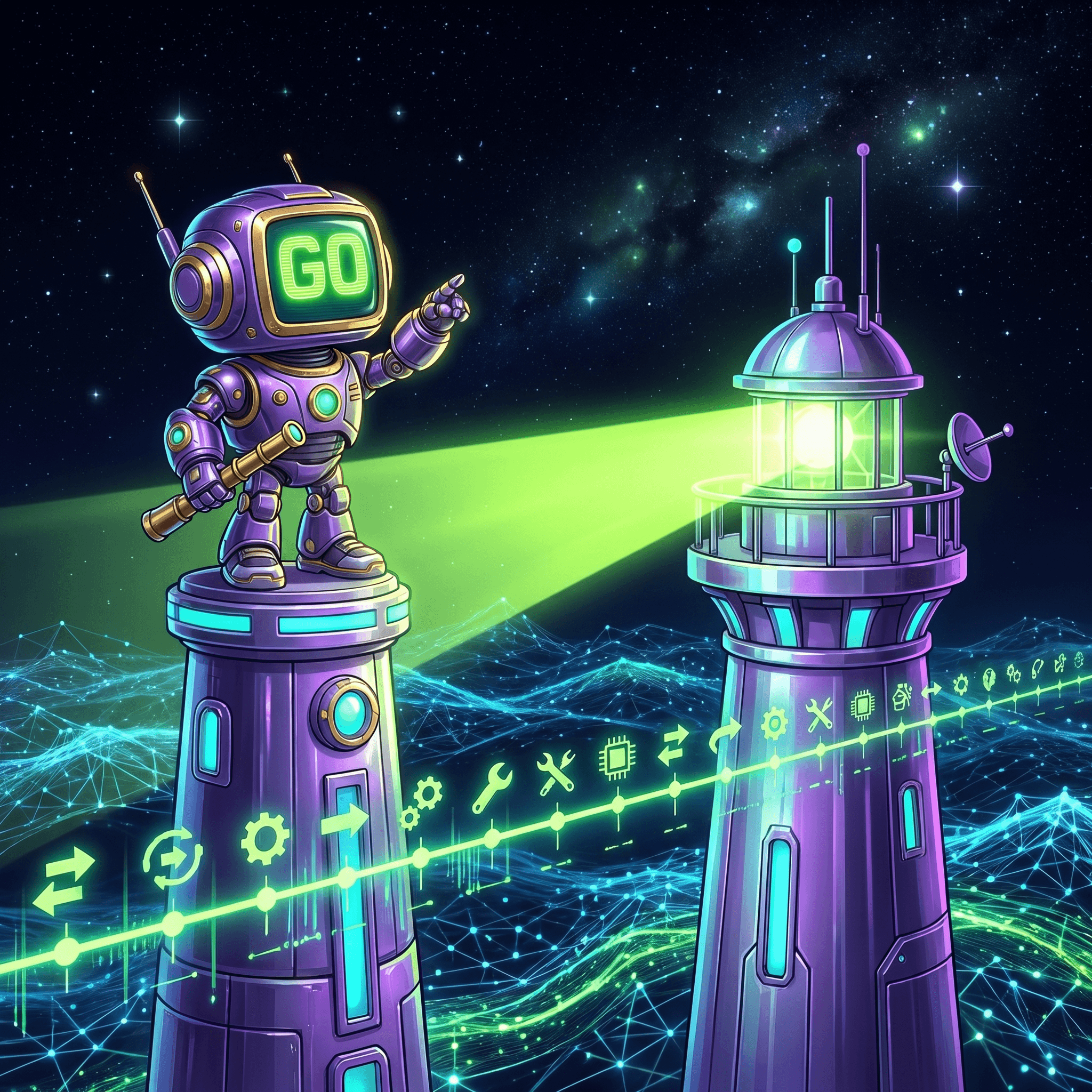
Most teams build the orchestrator first and add observability later. We did the opposite. The trace timeline existed before any specialist agent did, and every agent we’ve shipped since was built to write to it. That ordering is why we can replay any run, audit any decision, and roll back any change.
Build the rail first
When you build the trace second, every agent you shipped before it has its own ad-hoc logging format. You spend the next quarter writing adapters. When you build the trace first, every new agent inherits the format because there’s no other format to choose.
What a trace contains
- trace_id and parent_id for the run.
- Every hand-off (which specialist was called, with what input).
- Every tool call (verb, target, latency, idempotency key).
- Every model call (prompt, response, model, tokens, cost).
- Every decision (router intent, confidence, escalation status).
- Every outcome (success, soft-fail with warning, hard-fail with error).
Replay-first design
Because the trace is the source of truth, we can replay any run end-to-end. That’s what makes regression testing on agents tractable: ship a new specialist, replay yesterday’s 10k traces against it, diff the outputs, ship or revert.
Observability is also a product surface
We expose the trace in the customer dashboard. When a user reports a weird outcome, support asks for the trace_id and we look at it together. That changes what ‘support ticket’ means: we’re not guessing at logs, we’re looking at the same timeline the customer sees.
The same rail, in the products
The habit is not limited to agent runtimes. The products of our independent sister company GOTONOM are built the same way: a person can see what the system did, not only what it says it did. None of them calls this observability on its product page, but each one has a concrete version of it.
- GoPeople records every HR request with its approval history. An employee writes on WhatsApp, the message is classified, an authorised approver decides in the panel, and the result goes back to the employee. The whole process is recorded and reported, so HR can see who asked, who decided and when.
- GoVista shows playback analytics and device health for every screen, and sends an alert, in the dashboard or on WhatsApp, when a screen goes offline. A screen that loses its connection keeps playing the content it has already downloaded, and an operator can restart it remotely.
- GoTrack signs every webhook it sends with HMAC-SHA256, for pickup, return, touch_interaction, screen_paired, screen_offline and test events, so the receiving system can check that an event really came from GoTrack and was not changed on the way.
- GoTrack keeps working when a store’s internet drops: events wait on the device in the store and are sent when the connection returns, so a gap in the network does not turn into a gap in the data.
- GoTrack also publishes its measurements with their method. The screen reaction time and the offline test are lab notes on gotrackgo.com, each with the date it was measured and how it was measured.
Quiet failure is the expensive kind
A run that fails loudly costs an afternoon: you see it, you fix it. A run that fails quietly, and writes a plausible wrong answer into a report or into memory, costs far more, because nobody goes looking for it. The trace is how we tell the two apart. An agent that could not do its job leaves a failed step on the timeline, with the error attached, instead of an empty result that reads like a real one.
That gives us a rule we hold our own code to: “we could not check” and “we checked and found nothing” must never look the same. The first can be retried and stays out of every average; the second is real data. Even the App Store rating on this site follows it. Goddo’s rating is read from every country storefront it has ratings in, and if any one of those reads fails, nothing is shown, because a partial sum would show a smaller count as if it were the real one.
It is also why GoBot, our mascot, has a screen for a face. A good agent has nothing to hide, and you should always be able to see what it is doing.
“Observability isn’t a tab in the dashboard. It’s the runtime your agents live inside.”