Meet GoBot — the face of every agent we ship.
GOGOGO is a multi-agent company: dozens of small specialized agents, one runtime. So why do we have exactly one mascot? Because every agent we ship is a GoBot. Same core, different hat. Here's what GoBot is, why the design looks the way it does, and why one face for many agents is the most honest thing we could put on the product.
Atakan Özalan
Co-founder & engineering lead, GOGOGO LLC
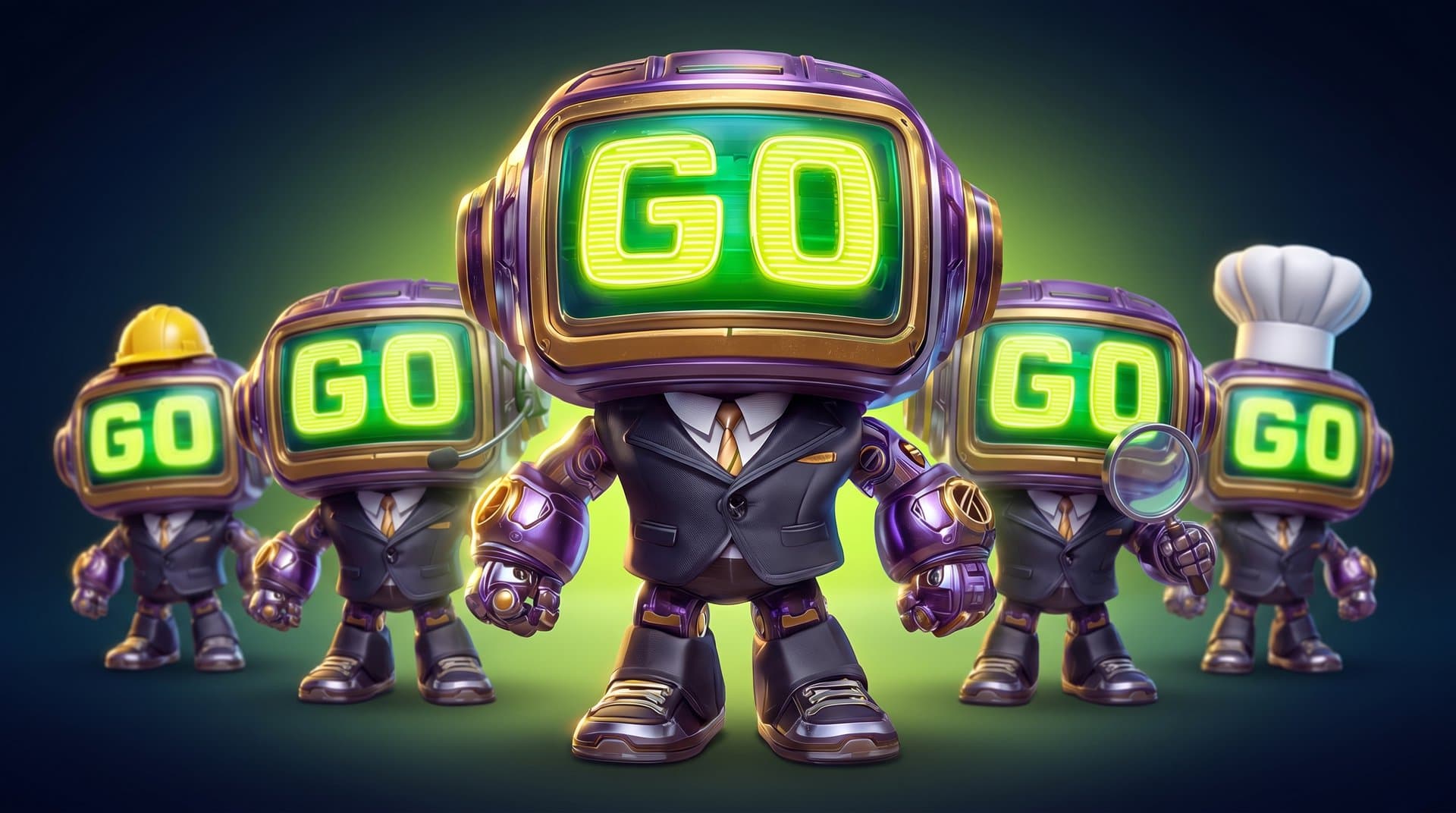
If you've read any post on this blog, you've seen him. Purple helmet. A brass-framed CRT screen for a face. A glowing green GO on that screen. That's GoBot — the mascot of GOGOGO LLC. He's on every blog cover, every product page, the about page. New visitors usually think he's decoration. He isn't. GoBot is a thesis about how our software is built, compressed into one character.
Here's the puzzle worth explaining. GOGOGO is a multi-agent company. Our runtime runs dozens of small, specialized agents — a retrieval agent, a reranker, a classifier, a generator, a router, an evaluator. Many agents, narrow jobs, working together. So the obvious branding move would be a cast — a dozen little characters, one per agent type. We deliberately didn't do that. We have exactly one mascot. This post is why.
What GoBot actually is
GoBot is a robot, and the three design elements are each load-bearing — none of them is just styling.
The purple helmet is the body. It's rounded, friendly, a little toy-like. That's deliberate: the agents we build do serious work — HR triage, retail operations, logistics — for people who are not AI engineers and don't want to be. The mascot has to read as approachable before it reads as technical. Purple because it's the GOGOGO brand color and because it isn't the color any other AI company reaches for.
The brass-framed CRT screen is the face — and it's the most important part. A CRT is an old, honest display: what you see is what the machine is doing, with no hidden layer. We put a retro screen where the face should be because the single value we care about most in agent systems is observability — you should always be able to see what the agent is doing. GoBot's face is a screen because a good agent has nothing to hide. The brass frame is the craft: this is built, not generated; assembled with care.
The glowing green GO is the runtime. Green is the live signal — the system is on, the agent is working, the trace is flowing. When you see the GO lit, the machine is running. It's the same green we use for every 'live' state across the product. GoBot's face literally displays the state of the system.
Why one mascot for many agents
Now the real question. If we run dozens of distinct agents, why one face?
Because that's architecturally true. Every agent in our runtime is the same kind of thing: a typed input contract, a job, a typed output contract, a trace, a grade. The retrieval agent and the generator agent are not different species — they're the same primitive doing different jobs. A reranker is a GoBot with a reranking hat. A classifier is a GoBot with a classifying hat. The core — observable, traceable, gradeable, replaceable — is identical. Only the job changes.
A cast of twelve different mascots would tell a lie about our system. It would imply twelve bespoke, specially-engineered creatures, each its own snowflake. That's exactly the architecture we don't build, because it doesn't scale and it can't be graded uniformly. One mascot in many hats tells the truth: one well-built primitive, specialized by role, multiplied. The branding is the architecture diagram.
“A multi-agent system done right isn't a zoo of exotic creatures. It's one honest primitive, wearing the hat each job needs. GoBot is one character because our runtime is one primitive — and the mascot should never lie about the machine.”
GoBot across the four products
Look at the product pages and you'll see it. The Goddo GoBot has a wizard's energy — it generates. The GoPeople GoBot wears a headset — it routes and triages. The GoVista GoBot works with screens and signage. The GoBot on the page for GoTrack — made by our sister company GOTONOM A.Ş. — has a camera; it sees what gets picked up. Four products, four hats, one unmistakable character. A customer who learns to trust GoBot on one product already trusts the next one, because it's visibly the same character. That transfer of trust is worth more than four clever separate mascots ever could be.
Why a mascot at all
AI products have a trust problem, and it's specific: the system is invisible, non-deterministic, and easy to anthropomorphize wrongly. People either over-trust it (treat it as an oracle) or under-trust it (treat it as a toy). A mascot, used honestly, is a calibration tool. GoBot is friendly — so you're not afraid of it. GoBot has a screen for a face — so you remember it's a machine, and you can see what it's doing. GoBot is a robot, not a person — so you don't mistake it for a colleague with judgment it doesn't have. The mascot sets the right expectation before the user reads a single line of copy.
He also keeps us honest. Every time we design a new agent, someone asks: would this be a GoBot? Is it observable — does it have a screen? Is it traceable — does the GO actually light up? If a proposed agent can't be drawn as a GoBot, that's a design smell, and we've caught real architecture mistakes that way. The mascot is a constraint, and good constraints make better systems.
So: when you see GoBot at the top of a post, he isn't decoration. He's the shortest possible statement of how we build — approachable, observable, live, one primitive in many hats. Say hello. You'll be seeing a lot of him. More on the company at gogogollc.com.