The 3am failure: trusting agents nobody is watching.
A multi-agent system earns its keep by running while you sleep. But autonomy means the failure also happens while you sleep — at 3am, with no human in the loop. The hard question of agent operations isn't 'how do we stop failures.' It's 'what should the system do when it fails and nobody is watching.' Here's how we answer it at GOGOGO.

Atakan Özalan
Co-founder & engineering lead, GOGOGO LLC
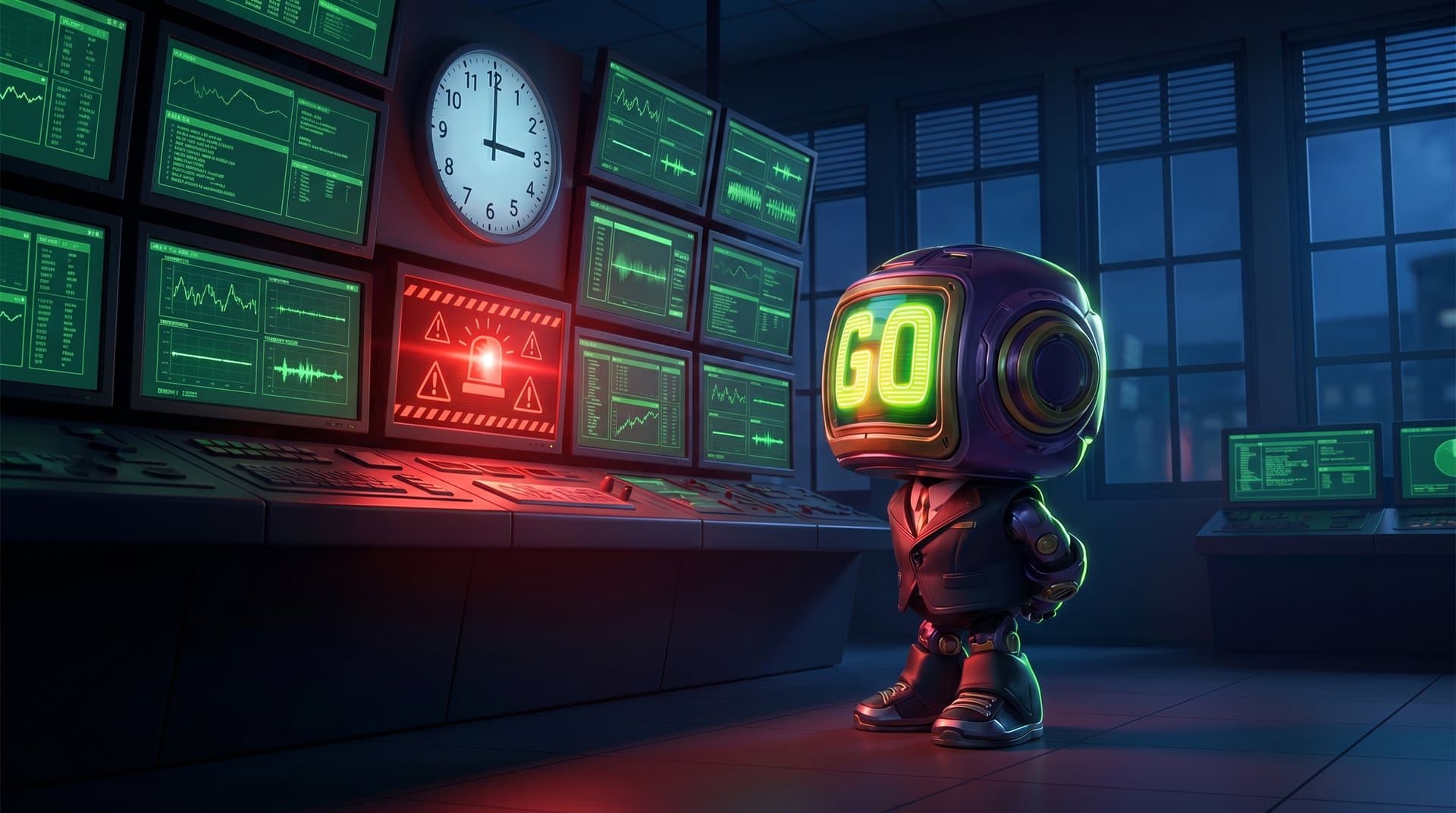
The whole point of an autonomous agent is that it works when you don't. A multi-agent system at GOGOGO LLC earns its keep overnight — processing, routing, generating, deciding, while the customer and our team are asleep. That's the value. That's also the problem. Because if the system runs at 3am, the system also fails at 3am, and there is no human in the loop to catch it.
Most writing about agent reliability is about preventing failures. That's necessary and it's not enough, because failures are not fully preventable — a non-deterministic system will eventually do something wrong. The question that actually decides whether you can be trusted is the one most teams don't design for: what does the system do when it fails and nobody is watching?
Failure modes are not equal at 3am
During the day, every failure is roughly fine, because a human will see it and judge it. At 3am the failures sort into a hierarchy, and you have to design for the hierarchy, not the average.
The loud failure — the agent errors, stops, and logs. This is the good failure. Nothing wrong happened to the customer; work is paused, not corrupted. A loud failure at 3am can simply wait for morning.
The silent-wrong failure — the agent produces a confident, wrong output and carries on. This is the failure that ends companies. Nobody sees it, the wrong result flows downstream into memory and into other agents, and by morning it has spread. The whole job of 3am design is to convert silent-wrong failures into loud failures.
The runaway — the agent doesn't stop. It retries, loops, or escalates its own actions, and every iteration costs money or does damage. A runaway at 3am, discovered at 9am, is six hours of compounding. This one can't wait for morning, so it needs a hard limit the system enforces on itself.
The four rules we run by
Here is how we make a system trustworthy to leave alone. None of it is exotic; the discipline is in actually doing it before the autonomy, not after the first bad night.
1 · Fail loud by default
Every agent's default behavior on uncertainty is to stop and log, never to guess and proceed. A paused job is recoverable in the morning; a wrong result that shipped is not. This costs you some throughput — agents stop on cases a human would have waved through — and that trade is correct. We tune toward stopping.
2 · Hard budgets the system enforces on itself
Every autonomous run has ceilings it cannot exceed: a token budget, a wall-clock limit, a maximum number of retries, a cap on external actions. When a run hits a ceiling it halts itself and escalates. This is the only defense against the runaway, because the runaway by definition won't stop on its own. The budget is not a performance setting. It's a safety device.
3 · The blast radius is bounded before you sleep
An overnight agent gets the narrowest permissions that still let it do the job. It can draft but not send; stage but not publish; flag but not delete — unless a specific action has been explicitly, separately trusted for autonomy. The question before you leave a system unattended is never 'will it fail?' It's 'when it fails, what is the worst thing it can reach?' You answer that by limiting what it can reach.
4 · Morning gets a full trace, not a vibe
Whoever opens the dashboard at 9am must be able to see exactly what happened all night — every run, every grade, every halt, every escalation, each tied to a replayable trace_id. Not a summary. Not a feeling. The overnight system's job includes leaving a complete, honest account of itself for the morning. A night you can't reconstruct is a night you can't trust.
“You don't earn the right to run unattended by never failing. You earn it by failing loud, failing bounded, failing inside a small blast radius, and leaving a trace clear enough that the morning knows exactly what the night did.”
Trust is a property you engineer
When a customer asks 'can I trust this to run overnight?' they usually hear it as a question about the AI's intelligence. It isn't. It's a question about operational design. A modest agent with loud failure, hard budgets, a bounded blast radius, and honest tracing is trustworthy. A brilliant agent with none of those is not — it's just a brilliant agent you'll have a very bad morning with, eventually.
So we don't sell autonomy as 'the agent is smart enough to leave alone.' We sell it as 'the agent is built to be left alone' — and those are different claims, with the second one being the only honest one. The 3am failure is coming for every autonomous system. Whether it's a non-event or a disaster was decided at design time, by you, while it was still light out. More on how we build at gogogollc.com.