What a Metin2 server taught me about distributed systems.
As a kid I ran a PvP server for an MMO called Metin2. I thought I was running a game. I was actually running my first distributed system — a live economy, a load problem, an abuse surface, and a few hundred users who'd find every bug in minutes. Everything I do now in multi-agent systems, I first learned wrong, then right, on that server.

Atakan Özalan
Co-founder & engineering lead, GOGOGO LLC
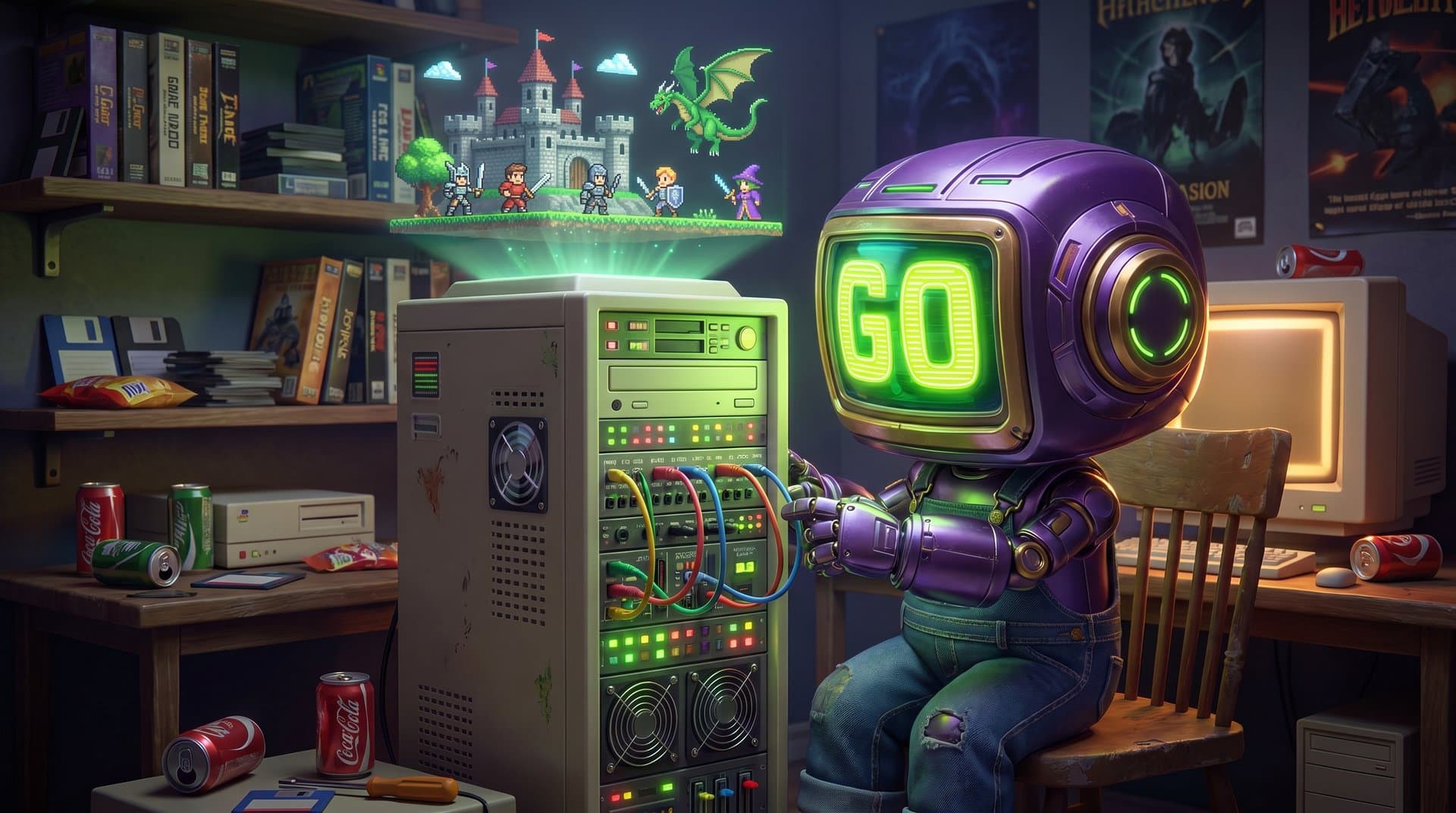
Before I ever heard the phrase 'distributed system,' I ran one. As a kid I hosted a PvP server for an MMO called Metin2 — one of the games I lived inside growing up. In my head I was running a game. Looking back, I was running my first real production system: a persistent world, a live economy, a few hundred concurrent users, an abuse surface, and an uptime expectation. I learned more engineering from that server, mostly by breaking it, than from any course I took later. This is what it taught me — because every lesson came back, years later, in multi-agent systems at GOGOGO LLC.
Lesson 1 — Users are an adversarial load test
The first thing a player base teaches you is that you cannot imagine how your system will be used. I'd tune a server setting, feeling clever, and within minutes a player had found the combination of actions that turned my clever setting into a duplication exploit or a crash. Not one player — the population. A few hundred people, all poking your system at once, will find every edge you left, fast.
That stopped feeling like an attack and started feeling like a service. The players were a free, relentless, adversarial test suite. I learned to design assuming the worst input would arrive, because on a live server it always did, immediately. When I build multi-agent systems now, I assume the same: the input I didn't think of is already on its way, and the eval harness exists to be the adversary before the customer is.
Lesson 2 — A live economy is a feedback loop you can break
The Metin2 server had an economy: drop rates, currency, item values, player trading. I treated those numbers as settings. They were not settings — they were a feedback loop. Bump a drop rate slightly and the in-game currency inflates, prices distort, and a week later the whole economy is broken in a way no single change looks responsible for.
That was my first real encounter with a system that reacts to your changes — where you can't reason about one variable in isolation because everything is coupled through the players' behavior. A multi-agent system is exactly this. Change one agent's prompt and the agents downstream of it behave differently, and the effect shows up three steps away. You cannot tune one agent in isolation any more than I could tune one drop rate. You change it, you watch the whole economy, you measure.
Lesson 3 — State corruption is the real enemy
A crash on the Metin2 server was annoying but honest — it went down, I restarted it, players grumbled, life continued. The thing that genuinely hurt was state corruption: a bug that didn't crash anything but quietly left a player's inventory, or the economy, in an impossible state. By the time you noticed, the bad state had spread through trades, and there was no clean point to roll back to.
That taught me to fear silent corruption far more than loud failure. It's exactly why, today, I'm fanatical about observability and replayable runs. A multi-agent system that fails loudly is fine — you see it, you fix it. A multi-agent system that quietly writes a wrong fact into memory and carries on is the Metin2 corrupted-inventory bug, grown up. Loud failure is a nuisance. Silent bad state is the thing that kills you.
Lesson 4 — You are always on call
A game server doesn't care about your schedule. Players were online when I was at school, asleep, eating dinner. The server had to hold without me. I couldn't be the thing that kept it running — the system had to keep it running, and my job was to build it so it didn't need me at 3am.
That reframed engineering for me permanently. The goal was never 'a system I can run.' It was 'a system that runs without me.' Every founder lesson and every architecture decision since has had that shape — including why a small team like ours can run several products on one runtime. You don't scale by working more hours. You scale by building the thing that doesn't need your hours.
“I thought I spent my childhood playing a game. I was actually getting a decade of head start on production engineering — adversarial load, coupled economies, silent state corruption, and uptime without me. The server was the syllabus. I just didn't know it had a name yet.”
Why I tell this story
Not for nostalgia. I tell it because the most useful engineering education I got didn't look like education — it looked like a kid trying to keep a game server alive for his friends. The lessons were real because the stakes were real: if the server went down, actual people lost their evening. That's a better teacher than any assignment with a grade.
If you're young and running something janky and live — a server, a bot, a small site people actually use — you are not 'just messing around.' You're getting the exact education I got. Take it seriously, write down what breaks, and notice that the shape of the lesson outlasts the technology by decades. More of the long arc at atakanozalan.com, or ezagor for the handle I've carried since those years.