Multi-agent vs. RAG: when each one wins.
RAG is a retrieval pattern. Multi-agent is an orchestration pattern. They solve different problems, and most teams that pick the wrong one rebuild the system within a year. Here's the decision tree we use to pick — with the failure modes that tell you, in retrospect, you picked wrong.

Atakan Özalan
Co-founder & engineering lead, GOGOGO LLC
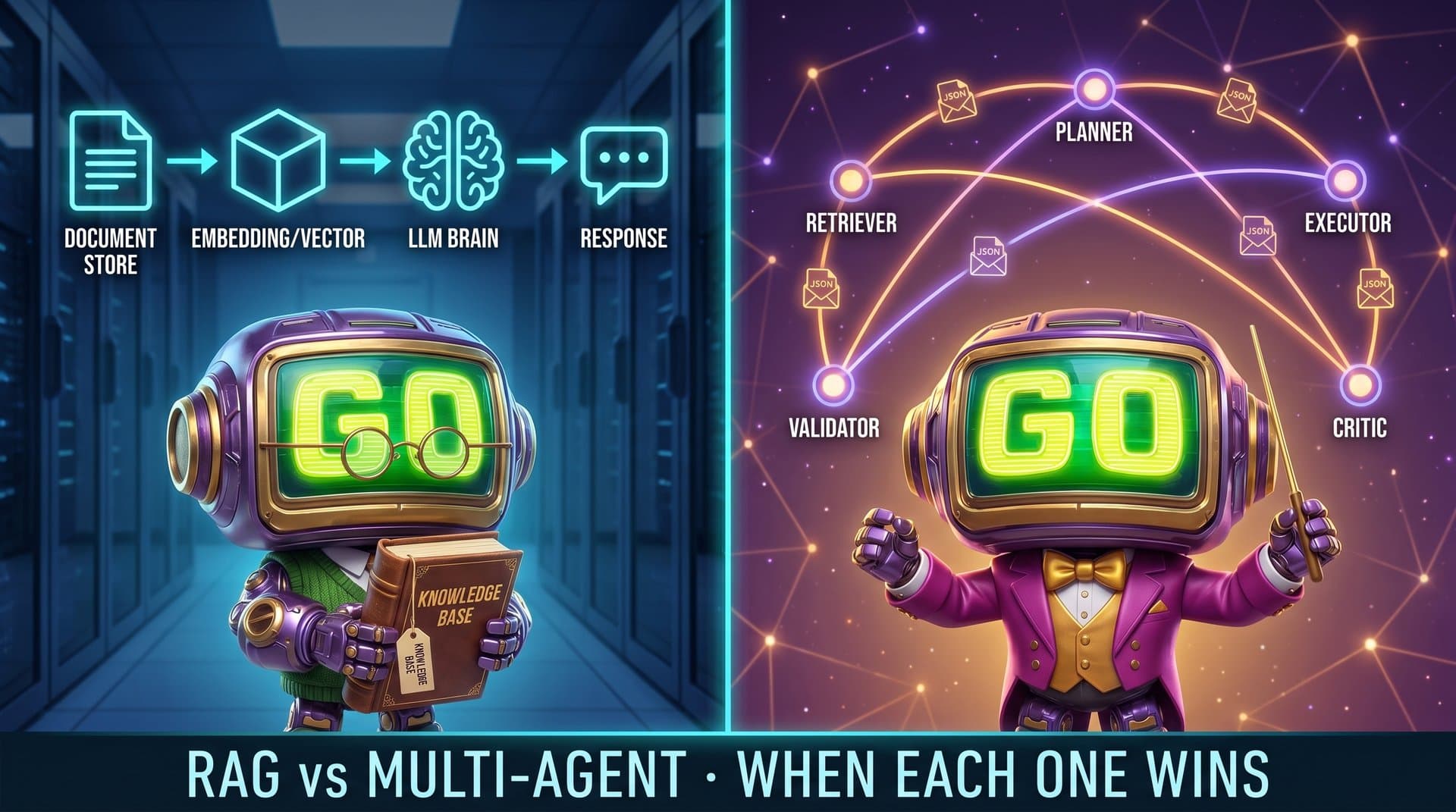
Half the engineering teams I talk to in 2026 ask the same question: 'should we build a RAG or a multi-agent system?' It's the wrong question. RAG is a retrieval pattern — how you give a model fresh context. Multi-agent is an orchestration pattern — how multiple specialised models cooperate. They're orthogonal. You can build a RAG inside a single agent. You can run multi-agent with zero retrieval. Most production AI does both.
But the question persists because teams pick one as their primary architecture, and that choice does matter. Pick wrong, and you spend the year afterward rebuilding. This piece is the decision tree we use at GOGOGO LLC across Goddo, GoPeople, and GoVista — plus the failure modes that tell you, in retrospect, you picked wrong.
What each one actually is
RAG (retrieval-augmented generation): the model gets a question, you embed the question, you find the K most similar chunks in your vector store, you stuff those chunks into the prompt, the model answers. One model, one round. Bigger context window or better embedding = better RAG. The model does the work; retrieval is fuel.
Multi-agent: you decompose a task into specialist roles (planner, executor, critic, retriever, validator) and let them hand off typed payloads to each other. One agent's output is another agent's input. The orchestrator is small and rule-shaped; the specialists are generative. Several models, several rounds. The structure does the work; generation is the last step.
When RAG wins
- Single-turn Q&A over a defined corpus. A help-center bot for your product docs. A legal assistant over your contracts. The user asks one question, the model gives one answer, the corpus you're retrieving from is bounded.
- Latency budget under 1 second. RAG is one model call (plus a vector search). Multi-agent is at minimum three (plan + execute + critic). For chat-feel responsiveness in front of users, the round-trip math forces RAG.
- Output is a paragraph, not a workflow. If the right answer is text, not a sequence of side-effecting actions (send an email, schedule a job, write to a database), RAG covers it cleanly.
- Cost per query has to be sub-cent. RAG ≈ one model call. Multi-agent ≈ N model calls. At scale this dominates the bill.
If the answer to all four of these is yes, build RAG. Multi-agent is overkill and will feel slower for users without giving them anything they'd notice.
When multi-agent wins
- The task is a process, not a question. "Compose, classify, and route this incoming customer message through HR, payroll, and IT" is not one model's job. It's GoPeople's job, and the decomposition is the whole product.
- Different parts of the task need different models. Vision for the image, retrieval for the catalogue, classification for the intent, generation for the response. RAG flattens this into one prompt; multi-agent lets each model be the best at its job.
- State outlives a single call. Multi-turn workflows where 'what happened in step 3' matters in step 7. RAG forgets between calls unless you reconstruct context; multi-agent treats the conversation graph as first-class.
- You need replay. Production debugging requires being able to re-run a failed task with the same inputs. Multi-agent traces give you that natively; RAG traces only give you the retrieved-chunks-plus-answer pair, which doesn't capture why the model answered the way it did.
If any two of these are true, build multi-agent. The cost of the extra orchestration is worth it the moment you have to debug anything.
The honest comparison table
// Same task — routing an incoming HR message — both ways.

// RAG approach (one model, contextually retrieved)
const candidates = await vectorStore.search(message.embedding, k=20);
const answer = await llm.complete({
  system: "You answer HR questions from the company policy handbook.",
  context: candidates.map(c => c.text),
  question: message.text,
});
// → string answer. Fast. Stateless. No replay.

// Multi-agent approach (specialists hand off)
const intent = await classifierAgent.classify(message);  // leave / payroll / docs
const policy = await retrievalAgent.fetch(intent, ctx);  // policy chunks
const decision = await validationAgent.confirm(policy, history);
const action = await workflowAgent.route(decision);
// → typed action, full trace of every step's input/output/decision,
//    replayable, debuggable, observable.
Both work. The RAG version ships in a weekend. The multi-agent version takes a month. The RAG version stops scaling at the first production bug you can't reproduce. The multi-agent version was built around being able to reproduce it. The decision is whether reproducibility matters more than time-to-first-demo.
Three failure modes that tell you, in retrospect, you picked wrong
Failure mode 1: You built RAG and your support team keeps asking 'why did it answer that?'
If you can't show a customer support engineer which retrieved chunks led to which sentence in the answer, your RAG is undebuggable, and you'll find yourself bolting agent-shaped scaffolding onto it within months. At that point, just rewrite it as multi-agent. We did this with the first version of GoPeople.
Failure mode 2: You built multi-agent and the demo is 4× slower than your RAG competitor
Multi-agent's strength is debuggability; its weakness is round-trips. If your task genuinely is single-turn and you wrapped it in 3 agent calls because it felt 'more right', you spent your latency budget on orchestration you didn't need. Collapse it back to a single agent with strong retrieval.
Failure mode 3: You picked RAG and now you can't represent the 'why' of a decision
Banking, healthcare, compliance — any domain where you have to defend why a system did what it did. RAG gives you the answer; multi-agent gives you the path to the answer. If a regulator is going to ask, you need multi-agent.
How we use both at GOGOGO
Inside each multi-agent system, the retrieval agent does RAG. The retrieval agent is one specialist among many; its job is to fetch fresh context and pass it to the next agent. So a retrieval step with a reranker is RAG (vector search + cross-encoder), but in our systems it sits inside a multi-agent runtime that also has classification, validation, and action agents.
Multi-agent is not the opposite of RAG. Multi-agent is the container RAG runs inside when retrieval is one of several things your system has to do. If retrieval is the only thing — RAG alone. If retrieval is one of many — multi-agent, with RAG as one specialist.
Decision tree, condensed
- Single-turn, latency-bound, text-out, sub-cent cost → RAG.
- Multi-step process, multiple model types, stateful, needs replay → Multi-agent.
- Unsure → start with RAG inside a multi-agent shell. The shell is cheap; rewriting later is not.
“RAG is fuel. Multi-agent is the engine. The question isn't 'which one' — it's 'when is fuel-alone the answer, and when do you need an engine to burn it inside.'”
We've built both at GOGOGO LLC and we keep both in the toolbox. If you want to compare notes on a specific decision in your stack — Atakan, or ezagor if you want the dev handle.