I-Ching as a multi-agent design pattern.
Eight trigrams. Eight agent role archetypes. The 4,000-year-old framework for understanding how forces combine maps surprisingly cleanly onto how specialised agents combine into a working system. Here's the pattern we ended up with, and what each trigram actually contributes.

Atakan Özalan
Co-founder & engineering lead, GOGOGO LLC
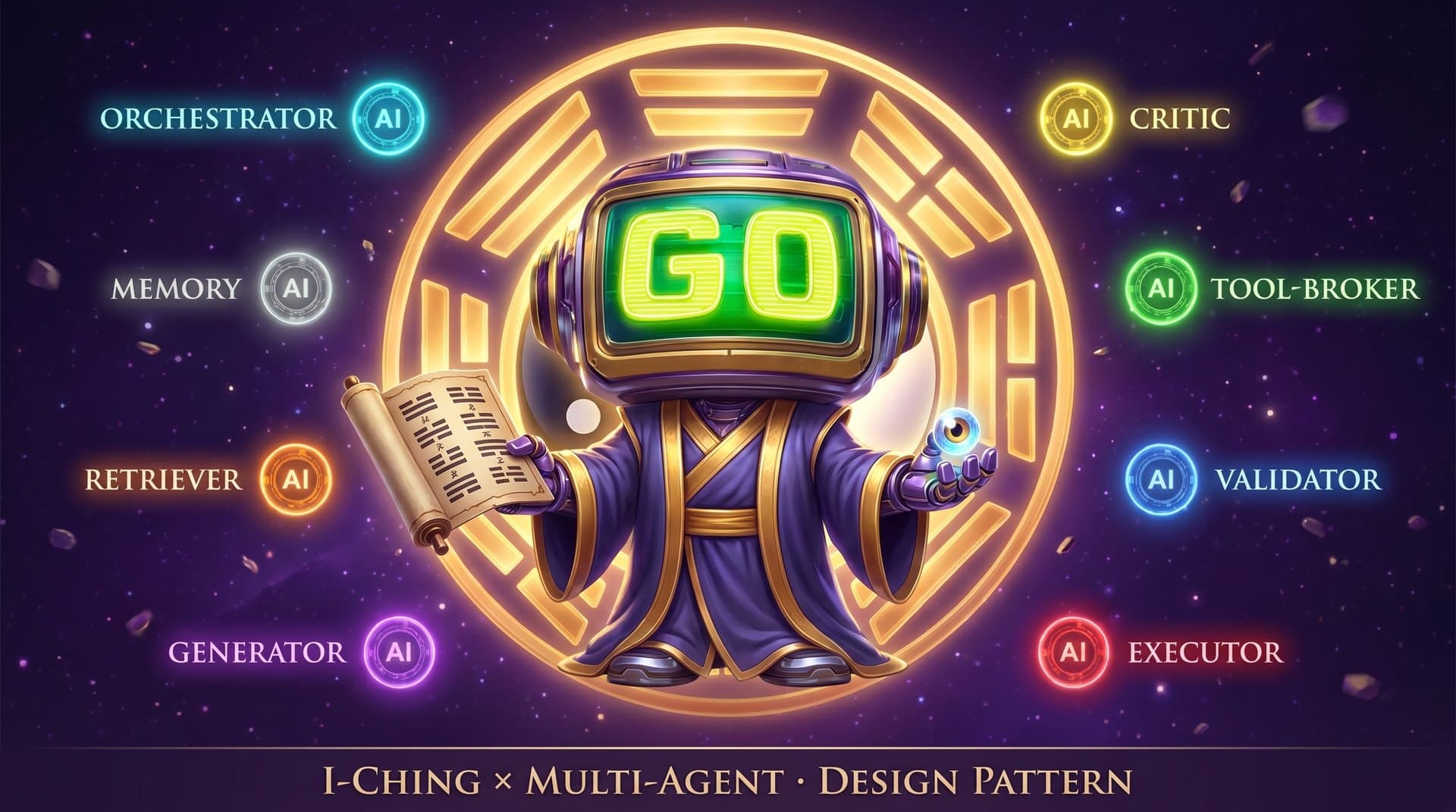
I've been reading the I-Ching since university. It sat next to my Jung and my Freud on the same shelf — a frame for thinking about how forces combine to produce situations, not a fortune-telling device. When we started building the multi-agent runtime at GOGOGO LLC, I noticed something: the eight trigrams (八卦, bāguà) map surprisingly cleanly onto the roles a working agent system needs.
This isn't mysticism. It's that any framework someone spent 4,000 years polishing for describing how forces interact will have caught something durable. The trigrams gave us a vocabulary for talking about agent roles that we couldn't get from CS literature, and a sanity check on whether our system was complete. Here's how it shook out.
The eight trigrams as agent roles
Western literature: 'orchestrator + specialists.' That's two roles. The I-Ching is more precise:
☰ Qián (Heaven) — the Orchestrator
The creative force. Decides direction. In agent terms: the orchestrator that picks the next specialist and routes the typed payload. Small, rule-shaped, deterministic. Most teams build this first; many never build any other role properly.
☷ Kūn (Earth) — Memory
The receptive force. Holds what was given. In agent terms: the memory layer — short-term context, long-term storage, conversation history, run state. Without it, every agent call starts from scratch. Most teams build memory third and regret not building it first.
☵ Kǎn (Water) — the Retriever
Water flows around obstacles to find what's there. In agent terms: retrieval — finding the right fact from the corpus, the right SKU from the catalogue, the right past message from the history. Vector search, FAISS, rerankers all live here. A retrieval agent with a reranker is a pure-Water agent.
☲ Lí (Fire) — the Generator
Fire illuminates. The generative specialist — the LLM doing the actual writing, the diffusion model doing the actual rendering. Goddo is full of Fire. Most agent teams have too much Fire and not enough of the other seven.
☳ Zhèn (Thunder) — the Executor
Thunder is action. The agent that does the side-effecting thing — sends the email, calls the API, writes to the database, swaps the signage. Often the riskiest agent because actions in the real world can't be un-done. Needs the strongest typing.
☶ Gèn (Mountain) — the Validator
Mountain is stillness, the immovable check. The agent that asks 'is this output safe / correct / on-brand / within policy?' before letting it through. Eval harnesses live here. Schema validators live here. Compliance checks live here. Many systems skip Mountain entirely; they're the systems that ship hallucinations to production.
☴ Xùn (Wind) — the Tool-Broker
Wind penetrates softly into everywhere. The MCP-server, the function-calling adapter, the bridge between agents and the world's APIs. Tool routing, retries, idempotency — all Wind.
☱ Duì (Lake) — the Critic
Lake reflects. The agent that reads another agent's output and produces a critique. Self-critique, peer-critique, score-and-revise loops. Used carefully, Lake doubles output quality. Used carelessly, it doubles latency without changing anything.
Tài (☷☰) — and the eighth role: the Observer
The composite trigrams of Earth-over-Heaven form 泰 Tài — peace, equilibrium. The Observer is what holds the system in equilibrium: the trace recorder, the eval pipeline, the OpenTelemetry layer. The Observer doesn't act; it watches. We covered this in Observability is the orchestrator. The system that has no Observer is the one you can't debug.
How to use the pattern
When designing a new agent system, ask: 'which trigram am I missing?' The roles that aren't present are the roles that will fail in production. If your system has:
- No Earth — every agent call starts fresh, conversation feels amnesiac.
- No Mountain — hallucinations slip through to users.
- No Lake — output quality plateaus and you can't say why.
- No Tài (Observer) — you can't reproduce a single bug a customer reports.
- Only Heaven and Fire — you have an orchestrator and one LLM, and you'll be back here in three months asking why nothing replays.
Why this framework outlasts model upheaval
Frameworks come and go. LangChain, AutoGen, CrewAI, MCP — each one frames the agent problem differently, and each one will be replaced by another within two years. But the eight roles don't change. The orchestrator role doesn't change when the orchestrator's implementation library does. The validator role doesn't change when you swap one schema library for another. The trigrams describe the structure of the work, not the structure of the code.
We chose this framework because it forces completeness. Western design patterns let you build a Hero + Sidekick and call it an agent system. The eight trigrams won't let you off that easily — they'll point at Earth, Mountain, Tài, and ask you where they are. Usually the answer is: 'I haven't built them yet,' and that's the work waiting for you.
“Eight forces, one system. You don't have to believe in the I-Ching to use it as a checklist. You just have to admit your agent system isn't done until all eight roles are accounted for.”
Where this came from
I read the I-Ching during my five-or-six year quiet period at university — alongside Jung's archetypes and Freud — when I almost never spoke. The frame stuck. When I started building multi-agent at GOGOGO, the eight-role decomposition was already in my head; I just hadn't yet realised it had come from there.
The same instinct shows up in the ezagor catalog under 'I-Ching × Quantum' — an honesty algorithm pairing the sixty-four hexagrams with quantum randomness for provably-fair RNG in luck games. Different domain, same underlying belief: ancient frames for combining forces don't go obsolete when the technology changes.
If you want to argue about this with me — atakanozalan.com, or ezagor. The agent system at GOGOGO LLC is the eight trigrams in production form; Goddo, GoPeople and GoVista are products built on top of it.