Multi-AI agents vs. multi-agent systems — the words we chose.
Both phrases describe orchestrated AI. Only one describes what we ship. The two-word difference is small; the operational difference is large enough to choose between architectures.

Atakan Özalan
Co-founder & engineering lead, GOGOGO LLC
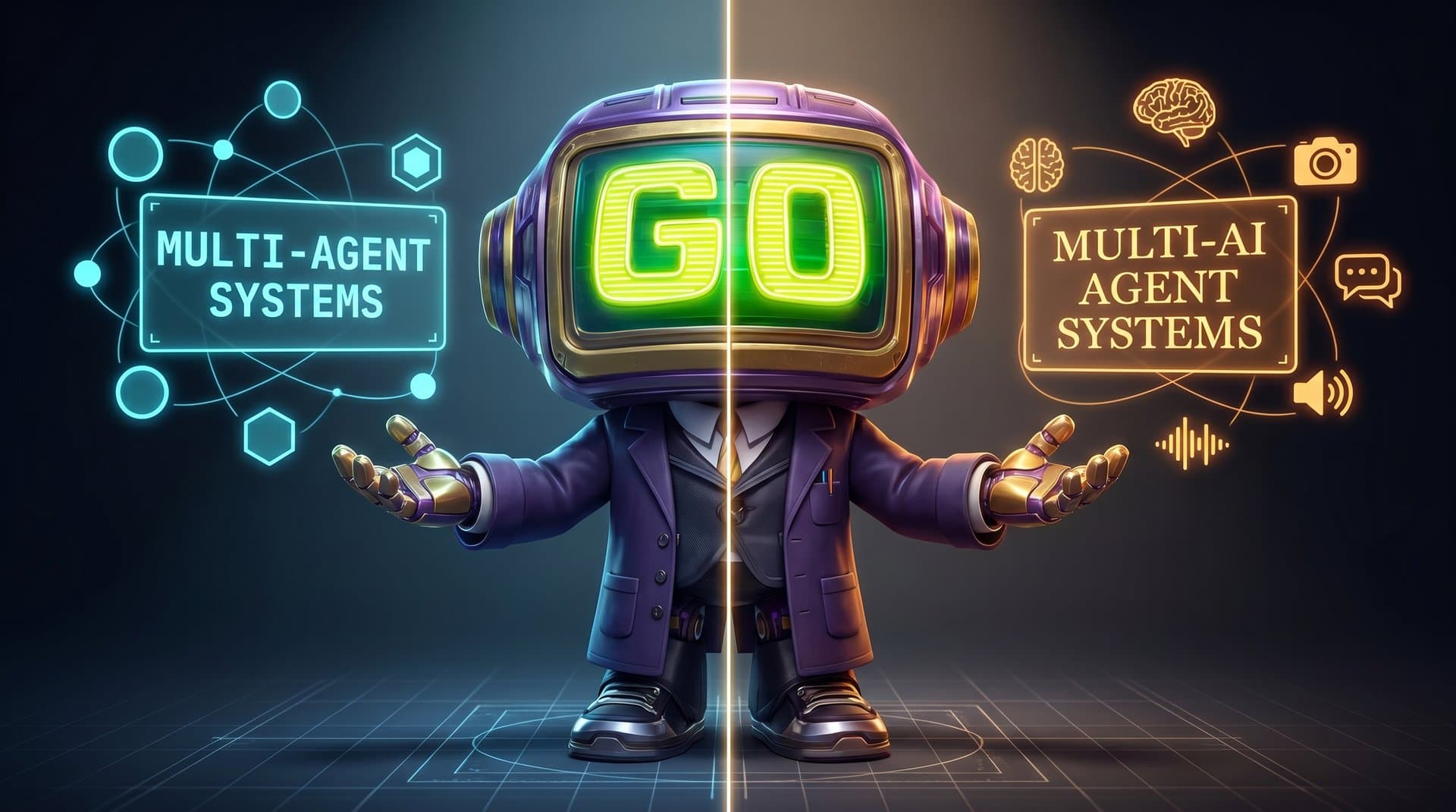
When we wrote the GOGOGO LLC About page in 2023, we landed on the phrase multi-AI agent systems. Three years later, we still use it everywhere — homepage hero, llms.txt, every product page. People sometimes ask why we don't just say multi-agent systems like the rest of the field. The two-word difference looks like a marketing choice. It isn't. It's an architectural one.
What 'multi-agent systems' actually means
Multi-agent systems is the older term, anchored in distributed-AI research from the 1980s. The canonical reading: multiple software agents — each one autonomous, goal-directed, capable of negotiation — collaborating to solve a problem one agent can't. The defining property is autonomy of each agent, not the diversity of what's inside them. Five agents all running the same LLM are still a multi-agent system.
It's the right term when the question is orchestration: who decides what, who hands off to whom, how do conflicts resolve. The classic agent-oriented programming literature uses it this way. So do most contemporary frameworks — LangGraph, AutoGen, CrewAI. They give you the orchestration scaffold and assume you'll bring whatever model you want.
What 'multi-AI agent systems' adds
Multi-AI is a tighter claim. It says: the agents in this system are running on multiple different AI models — different families, different modalities, different vendors — and the orchestrator's job is partly to know which agent runs on which model.
When we call a retrieval-heavy system multi-AI, we mean something like this: the retrieval agent runs vector search over an embedding model; the rerank agent runs a cross-encoder; the validation agent runs a small distilled classifier; the signage agent calls a text LLM; the observer runs a different LLM doing structured-output evals. Five agents, five different model families. The orchestration logic and the model-routing logic are the same logic.
Why the distinction earns its keep
1. Model selection becomes an architectural variable
In a pure multi-agent system, swapping the underlying model is a deployment concern — change the API key, rerun. In a multi-AI system, every specialist agent has its own model choice and its own swap budget. The retrieval agent gets a small, cheap embedding model; the critic gets a large reasoning model; the generator gets whatever's strongest for the modality. Mixing model classes is the design, not an optimization pass.
2. Vendor risk reshapes
If one provider has an outage, a multi-AI system degrades partially — the retrieval agent and the validator might still work even if the generator's vendor is down. A single-model multi-agent system goes fully dark with that vendor. We've shipped our products through three vendor-side outages in 2025; multi-AI is what kept most of them serving traffic through each.
3. Cost modeling becomes per-agent, not per-call
Multi-AI forces you to amortize: the cheap distilled validator runs on every request, the expensive generator runs only after the validator approves the trajectory. In a single-model multi-agent system, every agent pays the same per-token rate. The cost graph in production is fundamentally different.
When you should use which term
- Use 'multi-agent systems' if your value prop is orchestration patterns, agent autonomy, hand-off protocols, or workflow expressiveness. The agents could be running the same model and your claim would still hold.
- Use 'multi-AI agent systems' if the diversity of the models is the product — if a customer would notice that pulling out the cross-encoder or swapping the embedding model degrades the system. If model heterogeneity is load-bearing.
Why we picked the longer phrase
Every product we ship hits the multi-AI threshold. Goddo routes between an image diffusion model, a video diffusion model, a prompt-enhancer LLM, and an upscaler — four AI families. GoPeople classifies WhatsApp messages with a small intent classifier, runs HR workflows on a tool-using LLM, and validates outputs with a separate eval model — three families. GoVista is similar.
If we called ourselves a multi-agent company, the description would still be technically accurate. But it would imply the agents are interchangeable parts on a common substrate. They aren't. The model diversity is half the engineering. We wrote that into the company name.
On the SEO of the choice
There is also a small honest reason: "multi-agent systems" is a saturated query. "Multi-AI agent systems" isn't. We picked terminology that was both technically tighter and easier to own in search. Both motives applied. Neither is the only motive, and you should be suspicious of any company that claims otherwise about their naming choices.
“Naming is architecture. The phrase you put on the homepage decides what you do and don't have to build next year.”
If you're picking the term for your own company, we're easy to ask. Choose whichever fits. Just choose deliberately.