The brother model: founding GOGOGO with my brother.
We started GOGOGO LLC in 2023 — two brothers, equal partners, one company. Two years in, the question we get most is whether it works. This is the honest answer. Co-written by Atakan and Okan Özalan.
Atakan Özalan & Okan Özalan
Co-founders, GOGOGO LLC
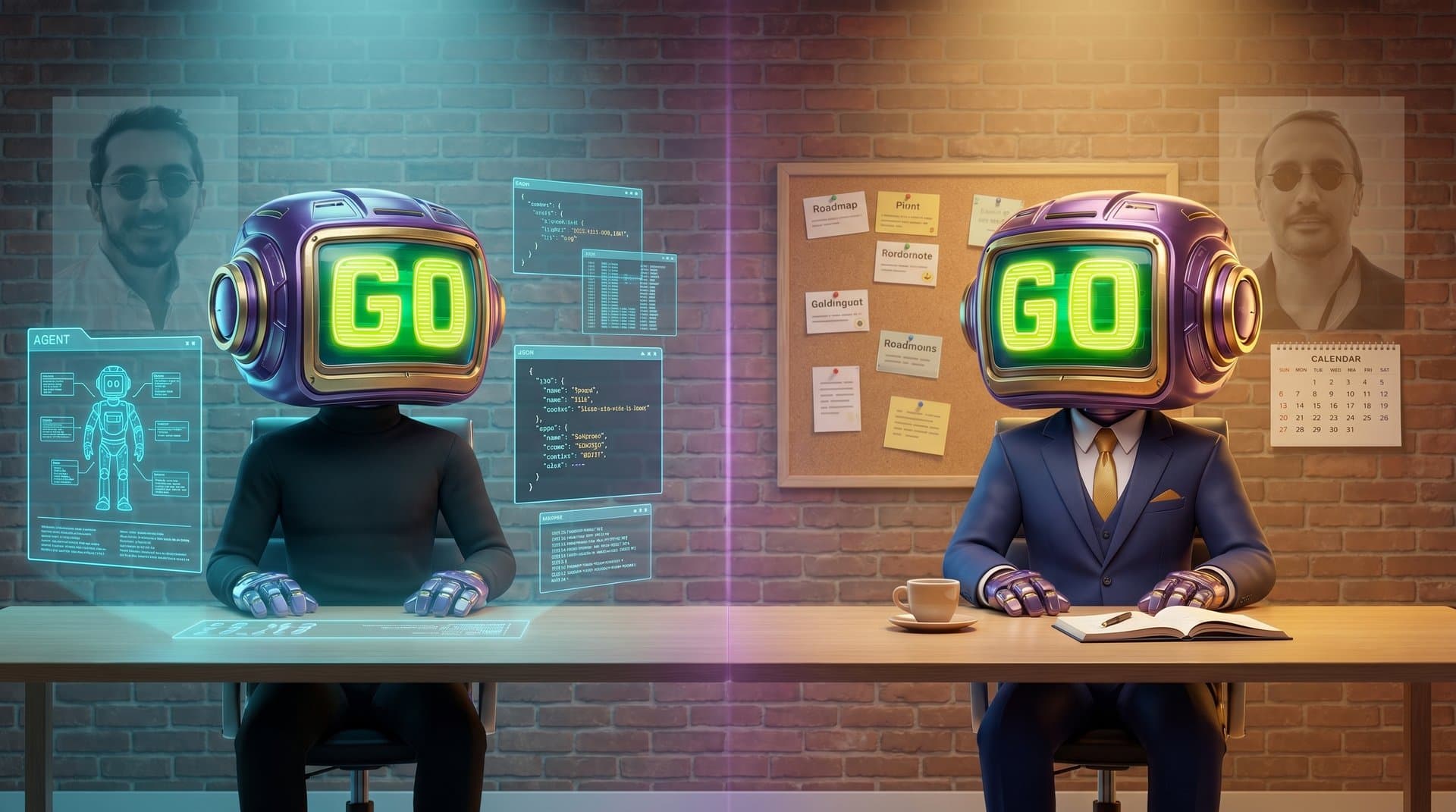
Atakan: When we tell people GOGOGO is run by two brothers, the reaction is split clean down the middle. Half lean in: "that's why it works." Half lean back: "that's the thing that breaks companies." We've been doing it for almost three years now. Both reactions have a point, and which one is right depends entirely on how you set the contract.
Okan: We're equal partners. 50/50. Different lanes — Atakan runs the engineering side, I run the operating side. I'm older by a few years. He's the engineering brain; I'm the operating brain. The split sounds neat in a slide and a lot messier when a customer escalates at 11pm on a Sunday. This post is about the messier part — what we wish someone had told us when we started.
Why we did it anyway
Most founder advice treats family co-founders as a yellow flag. The argument is sound: blood relationships pre-date the company by decades, equity disputes spill into Thanksgiving, exit liquidity asymmetries become inheritance fights. We knew all of this. We did it anyway.
The reason is unsentimental: we'd already worked together for fifteen years before incorporating. Okan ran a fishing-net components business at sixteen; I built bots on Turkcell BiP in 2015. We watched each other's career decisions across half a decade of dinners. By the time we filed the LLC in Delaware in 2023, we'd already shipped four side projects together and had absorbed each other's failure patterns. The information asymmetry that breaks most co-founder relationships in year one — "oh wait, I didn't realize you were like that under pressure" — was already paid down.
The two-brain operating model
Atakan: I own the engineering layer end-to-end. Orchestration, retrieval, evaluation, observability, the production LLM systems behind Goddo, GoPeople and GoVista. If something breaks at runtime, I'm on it. If a model needs swapping, I'm picking. If the architecture needs rewriting, I'm doing it.
Okan: I own product direction, operations, hiring, pricing, B2B partnerships, customer success. Roadmap and revenue. If a customer is unhappy, I'm the call. If we're hiring, I'm doing the late stages. If we need to fire someone, I'm doing that too. Atakan reviews the org-chart, but the operating decisions are mine.
Atakan: The split holds up because the territories don't overlap. There's no "director of engineering" question between us; engineering is one person's job. There's no "VP of product" question; product is the other's. The interfaces are clear: he hands me a problem to solve, I hand him a system that solves it. He hands me revenue targets; I hand him technical constraints those targets imply.
Three rules we wrote down in year one
Rule 1 — Bad news travels first
Okan: If something is broken on my side, Atakan hears it within an hour. Not in the morning, not at our next sync, not "once I've figured it out" — within an hour. Same the other direction. We've never had a company crisis where one of us was surprised about the existence of the crisis. Surprised about the severity, sometimes. Existence, never.
This rule is the only reason the operating model doesn't fork. The moment you start protecting your sibling from bad news, you've broken the contract and the company is downstream of that breach by six months.
Rule 2 — Veto rights are absolute, exercised rarely
Atakan: Either of us can veto any decision in the other's lane. We can do it once or twice a year. Beyond that you're undermining the partnership and we'd need to actually talk about whether the lane split still works. We've each used our veto exactly twice in three years. It's a load-bearing rule precisely because it stays in the holster.
Rule 3 — One company, one bank account, no side projects
Okan: Family businesses fail when one partner has a side investment the other doesn't. We don't. Every business activity goes through GOGOGO LLC. If one of us has a personal investment in something adjacent, it's disclosed and either folded in or wound down. This rule sounds anal-retentive until you see what it prevents — twenty years of "who funded what" arguments that destroy families.
Where the brother part actually shows up
Atakan: The brother part shows up at decision velocity. I can text him "swap GoVista's pricing tier from per-screen to per-zone, here's the math" and have a 30-minute call before lunch. There's no political subtext to parse. He's not protecting his career; I'm not building a personal moat. The decision either makes sense or it doesn't. That's an enormous edge in a category that moves as fast as multi-agent AI.
Okan: The brother part shows up under pressure. When a customer cancels, when a model release lands wrong, when a hire doesn't work out — neither of us is calculating whether the other is going to use it against us next quarter. We've already lived through worse together. The reset cost on a hard conversation is roughly an hour, not a week.
What we wish we'd done sooner
- Written contract before incorporation. We waited a year. The conversation was hard. The contract was easy. The order should have been reversed.
- External board member from day one. Two brothers without a tiebreaker is a stable system until it isn't. We added our external advisor in year two; should have been month one.
- Separate physical workspaces. We share a head office in Istanbul now, but we worked side-by-side every day for the first year and it eroded the lane split. The split survives when you can't see each other's screens.
- Named the partnership publicly earlier. We didn't make 'the Özalan brothers' framing visible on the company site for the first two years. Customers and investors keep telling us the family story is a trust signal. We should have led with it.
What this looks like in 2026
Atakan: Today GOGOGO LLC is three products — Goddo, GoPeople, GoVista — on one foundation. The multi-agent runtime I rewrote in 2025 powers all three; Okan runs the customer-facing operating system across all three. Our sister company GOTONOM A.Ş., founded by the same team, sits in Istanbul and makes GoTrack. We're equal partners with the same equity, the same liquidation preference, the same vote count. None of that has changed since day one. None of it should.
Okan: People sometimes ask which one of us is the "real" founder. The honest answer is that the company doesn't exist without both halves. Take either of us out of the partnership and you have a different company — smaller, slower, less honest. That's the whole bet of the brother model. Two operating systems, one company, fully calibrated by twenty-something years of knowing each other before the LLC paperwork.
“We don't recommend the brother model. We recommend the calibrated co-founder model, and for us, the calibration came from being brothers. The thing that matters is the depth of the prior — not the genetic relationship that produced it.”
If you're considering co-founding with a sibling — or with anyone you've already worked with for years — we're easy to find. Atakan, Okan, or info@gogogollc.com.