The agent that sleeps.
Your brain does its most important memory work while you're unconscious. Sleep isn't downtime — it's when the day gets sorted, compressed, and filed. Multi-agent systems have a memory problem that the same idea solves. This is the case for giving an agent a sleep phase: an offline pass where it consolidates, prunes, and — in a real sense — dreams.

Atakan Özalan
Co-founder & engineering lead, GOGOGO LLC
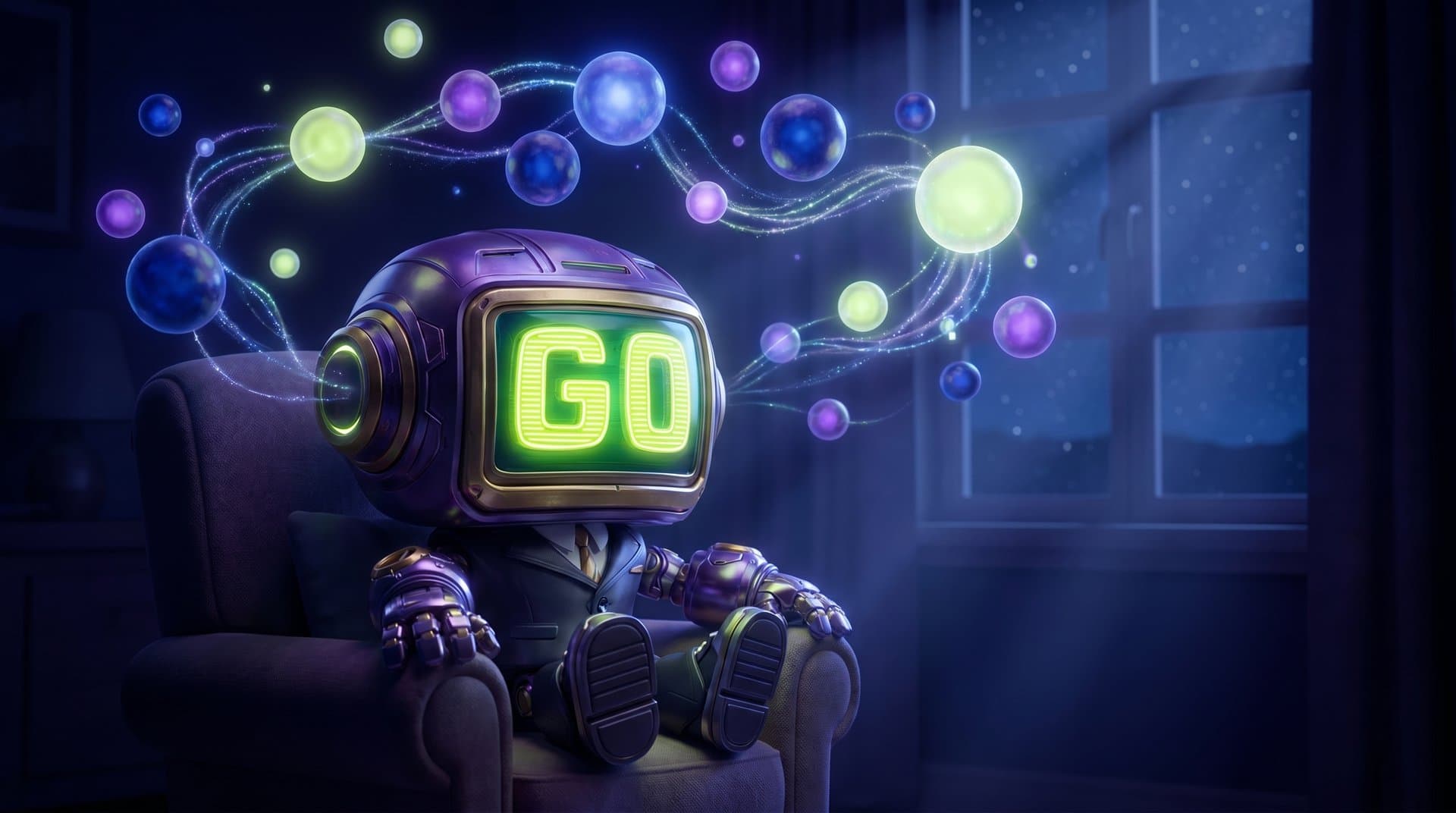
Here is a fact that should be stranger than it feels: you spend a third of your life unconscious, and that time is not wasted — it is when your brain does its most important work. During sleep, the day's experiences get replayed, sorted, compressed, and moved from fragile short-term storage into durable long-term memory. Sleep is not the absence of work. It is a specific, essential kind of work. I think multi-agent systems need it too, and at GOGOGO LLC this idea has quietly become part of how we build.
This post is half engineering and half a proposal. The engineering is real — we run it. The framing — calling it 'sleep,' calling part of it 'dreaming' — is a deliberate metaphor, and I'll be honest about where the metaphor is load-bearing and where it's just a good name.
The problem: an agent that only ever works while awake
I wrote before that memory is not a database — that a good agent has four memory layers, and that forgetting is a feature. But that post left a question unanswered: when does the sorting happen? When does raw experience — this run happened, that one failed — get distilled into durable knowledge?
If the answer is 'during the request,' you have a problem. A multi-agent system handling a live request is under time pressure. It cannot also, in that moment, thoughtfully reorganize everything it has ever learned. An agent that only ever works while 'awake' — while serving requests — never gets the quiet hour it needs to make sense of its own experience. It accumulates raw episodes and never digests them. It is, precisely, sleep-deprived.
The proposal: a sleep phase
So we give the system an offline phase — when no live requests are arriving — whose entire job is to process the day. We call it sleep because the analogy is exact, not cute. Three things happen in it, and all three have a direct human-sleep counterpart.
1 · Consolidation — moving short-term to long-term
During the day the system piles up episodic memory: raw records of individual runs. The sleep phase reads back over those episodes and distils them into semantic memory — durable, general facts. 'This customer asked about X three times this week' becomes 'this customer cares about X.' This is exactly what a sleeping brain does: it takes the day's specific events and extracts the durable pattern. Done live, it's a luxury there's no time for. Done in the sleep phase, it's the main event.
2 · Pruning — letting the unimportant fade
A sleeping brain also forgets, on purpose — it weakens the connections that didn't matter so the ones that did stand out. The sleep phase does the same: it scores the day's episodes for salience and lets the low-salience ones decay. An agent that pruned its memory live would be making that call under pressure. An agent that prunes while it sleeps makes it calmly, with the whole day in view. Forgetting, done well, is a nighttime job.
3 · Replay — the part I'll call dreaming
This is the part where the metaphor stops being decoration. A sleeping brain replays the day — it re-runs experiences, including ones that didn't happen quite that way, and learns from the replay. Our sleep phase does something genuinely similar: it re-runs the day's recorded traces, including the failed ones, against any changes we're considering. It asks, in effect, 'if I had been slightly different today, would the day have gone better?' It learns from runs that never happened. If you want a single word for replaying experience offline to learn from it, 'dreaming' is not a bad one.
What the system is like the next morning
An agent that has slept starts the next day measurably different from the one that went to bed. Its semantic memory is richer — yesterday's specific events are now general knowledge. Its memory store is lighter — the noise has been pruned, so retrieval is faster and cleaner. And its procedural memory has been updated by the replay — it has, overnight, gotten slightly better at its job. None of that happened while it was serving you. All of it happened while it was, in the only sense that matters here, asleep.
“We are used to wanting AI that never stops working. But a system that never stops to sleep never stops to learn from itself — it only accumulates. The most underrated phase of a multi-agent system is the hour it spends doing nothing for anyone, and everything for itself.”
The uncomfortable, useful idea
The instinct, when you build AI, is to maximize uptime — every minute not serving a request feels wasted. The sleep phase is a direct argument against that instinct. The quiet hour is not waste; it is when raw experience becomes knowledge, when clutter becomes clarity, when yesterday's failures become tomorrow's skill. We build it in on purpose now. An agent that only works while awake is not more productive — it is just more tired, forever. The best thing a system can do at 4am is not answer one more request. It's sleep on the day it had. More of how we think at gogogollc.com.