A day in the life of a token.
You typed a question. One of the words you typed is about to have a very eventful few seconds. This is the journey of a single token through a multi-agent system — narrated, for once, by the token itself. The most honest way to explain how the GOGOGO runtime works is to ride along with the smallest thing in it.
Atakan Özalan
Co-founder & engineering lead, GOGOGO LLC
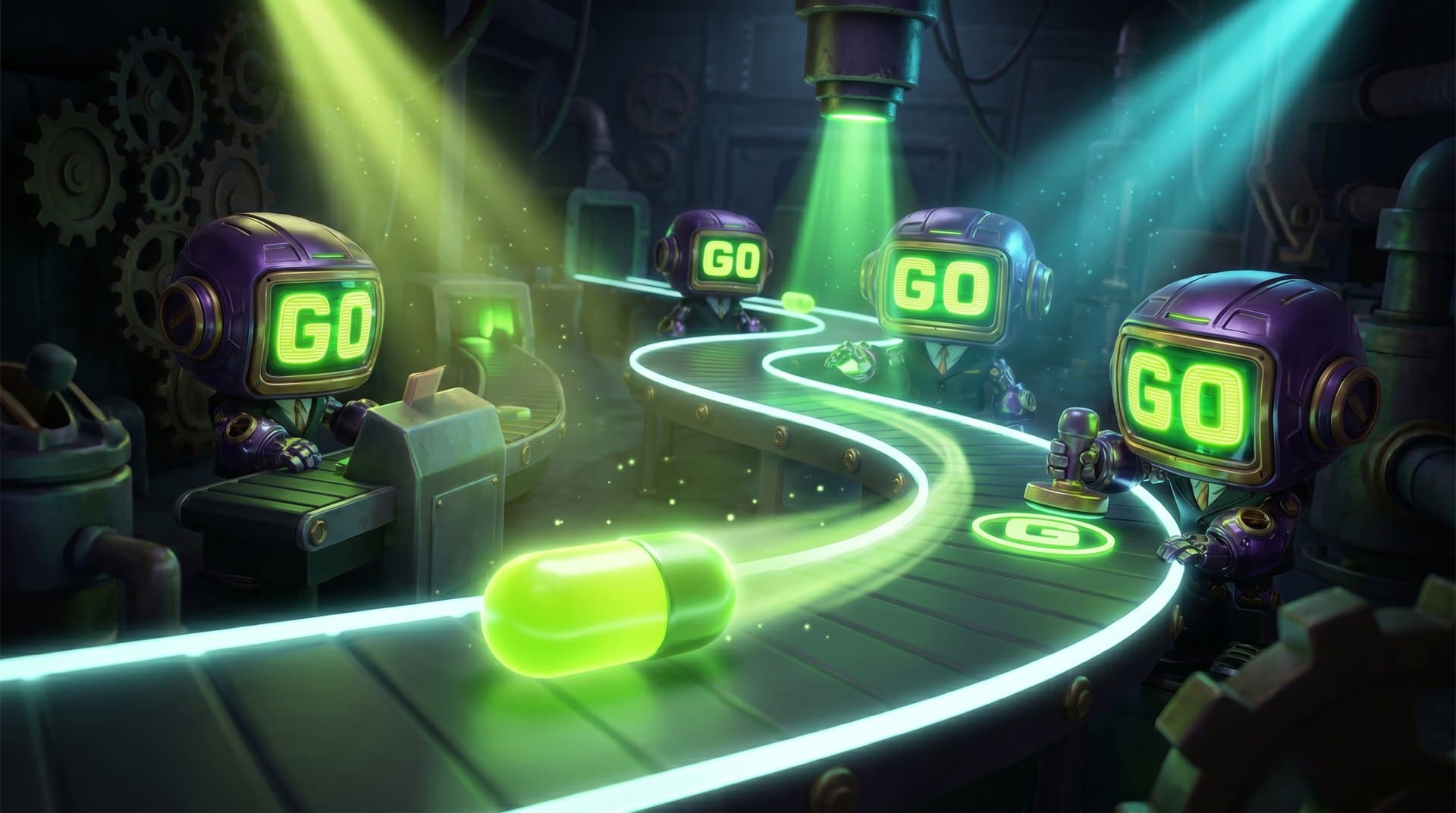
Most explanations of how a multi-agent system works start at the top — the orchestrator, the architecture diagram, the boxes and arrows. This one starts at the bottom, with the smallest thing in the whole system, and lets it talk. Meet a token. You created it a moment ago, without noticing, by typing a word. This is its day. Everything below is technically what happens inside the GOGOGO LLC runtime — just told from an unusual height.
06:00 — I am born
I did not exist until you pressed a key. You typed a question into a box, and a process called the tokenizer cut your sentence into pieces. One of those pieces is me. I am not quite a word — I might be a word, or half of one, or a comma. I am a token: the smallest unit this whole system thinks in. There are a few dozen of us from your one sentence, lined up in order, and we have no idea yet what we're in for.
06:01 — I become a direction
The first thing that happens is strange. I'm turned into a list of numbers — an embedding. My meaning becomes a position in a vast space where things that mean similar things sit close together. I don't feel like a word anymore; I feel like a direction. This is the system's real native language. From here on, nobody works with 'words.' They work with where we point.
06:02 — the orchestrator reads the room
Now I meet the first agent: the orchestrator. It doesn't do the work — it decides who does. It looks at all of us, the whole sentence, and works out what kind of request we are. A question that needs facts? A task that needs tools? It writes a plan. I'm not consulted; I'm just evidence. Then the orchestrator routes us, and my day forks.
06:03 — the retrieval agent goes looking
Because our sentence asked for facts, we're sent to the retrieval agent. This one takes our directions and searches a library — thousands of documents, each one also turned into directions long ago. It finds the chunks that point the same way we do. Suddenly I'm not alone with my sentence-mates anymore; I'm surrounded by tokens from documents I've never seen, pulled in because they're relevant. We go up to the next agent together, as a bigger crowd.
06:04 — the reranker is brutal
The retrieval agent was generous — it grabbed everything plausibly related. The reranker is not generous. It looks at the crowd of document-chunks that came back and throws most of them out, keeping only the few that genuinely answer the question. I watch tokens that travelled all this way get dropped here, three steps from the end. It feels harsh. It is also the difference between a sharp answer and a vague one. (We wrote a whole post on when retrieval is enough on its own; from down here, it's just the moment the crowd thins out.)
06:05 — the generator, where I might disappear
Now the survivors — my original sentence plus the few document-chunks that earned their place — arrive at the generator. This is the famous part, the agent that writes. It reads all of us as context and starts producing new tokens, one at a time, each one chosen based on everything before it. Here is the humbling truth of my day: I might not appear in the answer at all. I helped shape it — I was part of the context that steered every choice — but the output is made of new tokens, not me. I influenced; I was not copied.
06:06 — the evaluator checks the work
The new tokens — the answer — don't go straight to you. They go to the evaluator first. It checks: is this grounded in the documents the reranker kept? Did the generator invent anything? Does it match the required shape? My old crowd and I are used here as the reference the answer is checked against. It's the last useful thing we do. If the answer fails this check, the whole day runs again; if it passes, we're nearly done.
“A multi-agent system is not one machine thinking. It is a relay race, and the baton is meaning. Every agent holds it for one leg — route, retrieve, rerank, generate, grade — and hands it on. Watch a single token run the course and the whole architecture stops being a diagram and becomes a journey.”
06:07 — I become a line in the log
The answer reaches you. For you, the day is over — you read it in a second and move on. For me, there's an epilogue. The entire journey — every agent I passed through, every decision, every grade — gets written to the trace log under one trace_id. I end my day as a line in that record. It sounds like a small ending. It isn't: that log is the only reason a human can ever reconstruct what happened to me, debug it, or replay it. A token that isn't logged might as well never have lived.
Why tell it this way
Because the architecture diagram makes a multi-agent system look like static boxes, and it isn't static — it's a path that something travels. Route, retrieve, rerank, generate, grade, log. If you hold that journey in your head, every other post on this blog snaps into place, because they're all just close-ups of one station on the line. That's the whole system, seen from the height of the smallest thing in it. More on how we build at gogogollc.com.