GoTasty dev log: how do you design an idle game around Turkish street food?
Start from a real street: simit first, then çay, then döner, each a stall you work by hand before a crew takes over. How we designed GoTasty.

Co-founders, GOGOGO LLC
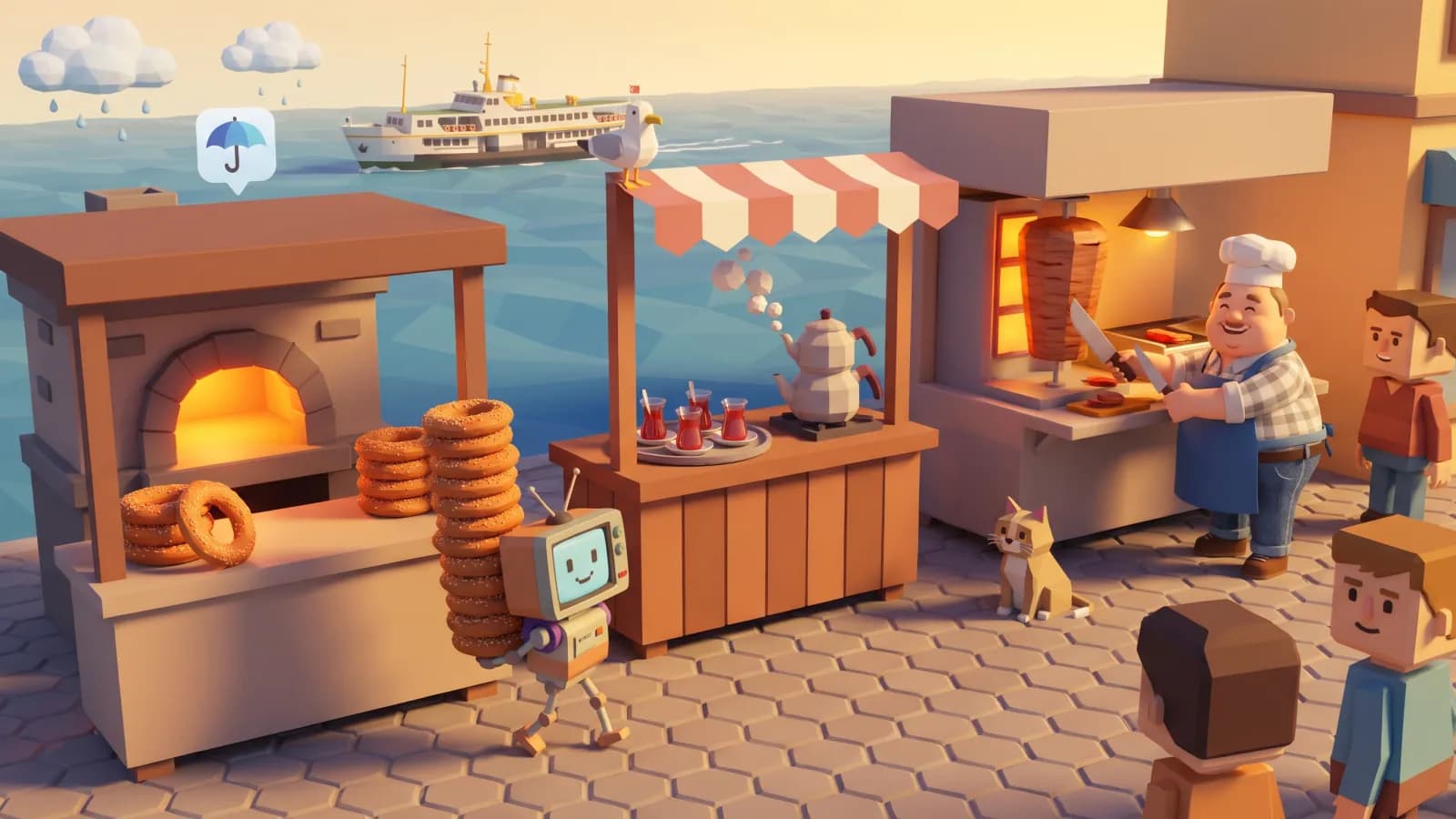
GoTasty is the first game from GOGOGO LLC: a low-poly 3D idle arcade about street food for Android and iOS, now in closed testing. It began with one street in Istanbul and a question we kept asking while designing it: what would a day at a real stall feel like if you could grow it into a restaurant? This dev log covers the decisions behind the loop, the stalls, the street life and the move from one street to 167 locations.
Why build an idle game around Turkish street food?
Because the food already has the structure an idle game needs. A simit oven, a tea stand and a döner counter are small, repeatable production lines with a clear rhythm: make, carry, sell, repeat. People recognise them, and in Istanbul they sit side by side on the same street. Street food is also local in a way that travels: every city has its own version, which gave us a natural way to grow the game later.
It is also our street. We are a small studio working from Istanbul, so the reference material was outside the door: the ferries, the simit sellers, the tea glasses and the cats.
What is the core loop?
One finger, five verbs. You walk to the oven or the grill, pick up what is ready, carry it as a stack on your back, fill the counter, and customers pay. You scoop up the cash, open the next stall and hire apprentices (çırak in Turkish) who take over a line so you can move on. Each stall grows from a stand into a shop and then a restaurant with a terrace.
Istanbul has five zones, opened in a fixed order so each one teaches something new:
- Bakery (simit). The tutorial stall: one oven, one product, one counter.
- Tea Stand (çay). A second, faster product, and the first reason to hire help.
- Döner Stand (dürüm). A two-step chain: slice from the spit, then wrap.
- Ayran & Tables. Customers sit down, and waiters carry plates to the tables.
- Döner Line 2. A second line that tests whether your crew can keep up.
How do you make a street feel alive?
With small systems, all written in code. Each station has its own animation: the döner spit turns and gets shaved, the simit oven glows, the tea stand pours. A day cycle runs from golden hour to evening every seven minutes. Rain showers send customers under umbrellas, and tea pays double in the rain. In Turkish cities there are street cats: feed a hungry one and tips go up by half for a minute, and every second cat you feed brings a new one to the street. Abroad there are no cats, because that is a Turkish street detail and it should stay one.
We set rules for the art too. People in GoTasty's key art show modern Istanbul in everyday clothes. Stalls in other countries never borrow the Turkish kebab grill or ayran fridge models, because they read as Turkish and would make a Naples street look wrong.
How do you tune the pace of an idle game?
With a bot and a stopwatch. A development build includes a bot that plays like an attentive player and logs its progress every 15 seconds, so we can see when each stall opens. Early runs showed the classic idle problem: once upgrades multiplied income, everything opened at once and the late game ran away. We softened the multipliers and taught the in-game guide (and the bot) to save for the next stall when it is close, instead of buying every upgrade on the way.
In one tuning run in October, the four stalls after the bakery opened at about 3, 6, 11 and 15 minutes. Those numbers keep moving as the economy changes, but the method stays: change one value in the config, run the bot, compare.
How did one street become 167 locations?
After Istanbul's three districts (Kadıköy, Eminönü and Beyoğlu) came İzmir, which forced us to make cities really different. İzmir got its own stalls: gevrek (İzmir's word for simit), boyoz, kumru, bomba and midye. The second stall there is a boyoz oven instead of a tea stand, so the rain bonus for tea does not apply. That rule, local food changes local mechanics, became the design principle for every city after it.
Hand-building every city did not scale, so we built a city kit: each city is a data file with its five stalls, products, colours, skyline and text in English, Turkish and Spanish, and shared stall types build it. As of 8 November 2026 GoTasty has 167 playable locations in 33 countries and more than 820 street foods. Atakan explains the engineering side on his site: how we ship a 3D Unity mobile game with AI coding agents.
What comes next?
GoTasty is in closed testing on Google Play and TestFlight, with the game in English, Turkish and Spanish. Next is the public release on Google Play and the App Store. You can explore the world map, the dishes and the trailer on the GoTasty page, or read how the studio works in how a two-founder studio ships AI products.
Sources
- GoTasty: Street food game around the world · GOGOGO LLC
- Set up an open, closed, or internal test · Play Console Help
- TestFlight · Apple Developer


