The social-media agent system, designed.
People keep asking us the same question: can you build an agent system that handles social media — branding, content, scheduling, analytics, the lot? Yes. And the reason yes comes easily is that a social media operation is already a multi-agent system. Here's the architecture, agent by agent.

Atakan Özalan
Co-founder & engineering lead, GOGOGO LLC
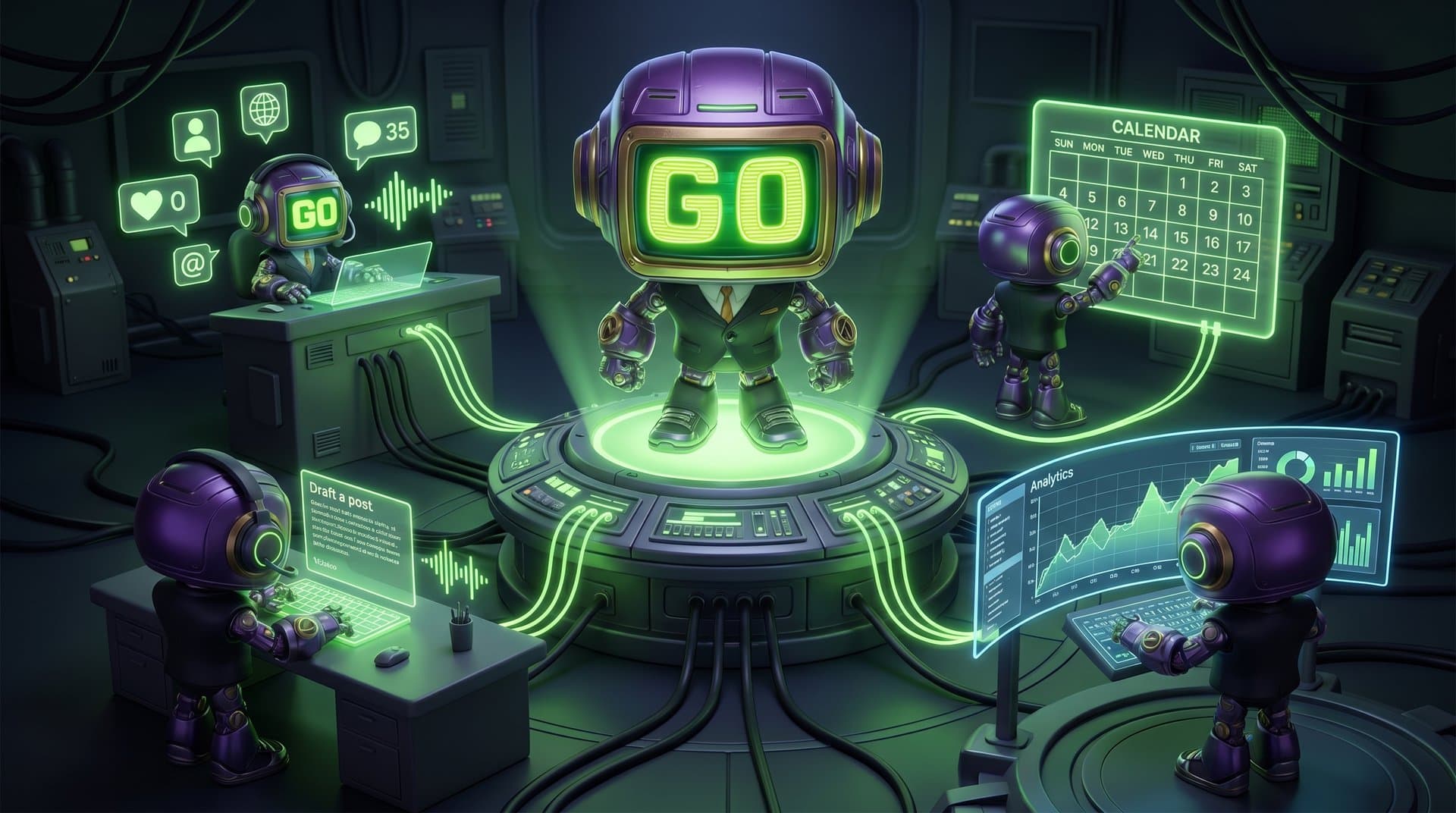
We get asked a version of this question often enough that I want to answer it properly, in public, once. Can you build an agent system for social media management — something that handles the branding, creates the content, schedules it, analyzes the results, and improves the content and the timing over time?
The short answer is yes, and the reason it's an easy yes is worth explaining. A social media operation is already a multi-agent system — it's just usually staffed with people and glued together with spreadsheets. The five things people ask us for are not five separate products. They are the agent roles of one orchestrated system. This post is that system, designed agent by agent — the way we'd build it at GOGOGO LLC.
It's a multi-agent system before AI touches it
Watch how a competent social media operation actually runs. Someone watches what's happening — the brand's mentions, the audience, what's landing. Someone decides what the brand should say this week. Someone writes the posts. Someone schedules them. Someone reads the numbers afterward. Someone feeds those numbers back into next week's plan.
That is an orchestrated multi-agent system — distinct specialized roles, coordinating toward an outcome, with a feedback loop. It already has the shape. Building it as an AI agent system is not inventing a new architecture; it's taking the architecture that's already there and implementing each role as an agent. That's why the request is so natural to say yes to.
The agents
Here are the agents of a social-media agent system, each with one job and a clear contract.
1 · The listener
Watches: brand mentions, audience activity, what's resonating, what competitors are doing, the state of each channel. It produces no content — its only output is an honest picture of the current situation. Most AI social tools skip this agent entirely and start at content generation, which is exactly backwards. You cannot say something worth saying without first knowing what's true right now.
2 · The strategist
Takes the listener's picture and the brand's goals and decides what to say and why — the themes, the priorities, the angle for the period ahead. This is the agent that holds intent. Without it, you get content with no spine — posts that are individually fine and collectively pointless.
3 · The content agent
Turns the strategist's direction into actual drafts — copy, the brief for an image, the shape of a post. This is the agent everyone thinks is the whole system, and it's one role of six. Critically, it works inside the brand-voice constraint — it does not get to sound like generic AI.
4 · The scheduler
Decides when each post goes out — not from a generic 'best time to post' chart, but from this audience's actual measured behavior. Timing is not a guess; it's a model the scheduler maintains and the analyst keeps correcting.
5 · The analyst
After posts go out, reads what happened — honestly. Not vanity metrics for their own sake, but: did this serve the strategy? The analyst's output is not a dashboard; it's a verdict that the next cycle can act on.
6 · The orchestrator
Ties the five together, holds the schedule of the whole cycle, routes the work, and — crucially — owns the human checkpoints. The orchestrator is not the smartest agent. It's the one responsible for the outcome.
Why six agents beats one big one
You could try to do all of this with one large prompt — 'be our whole social media team.' It demos well and fails in production, for the reason any multi-agent argument holds: you can't inspect it, you can't grade it, and you can't fix one part without disturbing the rest. With six agents, each has a typed job you can test in isolation. When the content is good but the timing is wrong, you know it's the scheduler. When everything is well-made but off-strategy, you know it's the strategist. The seams are where the system becomes debuggable — and a social presence you can't debug is one you can't trust with a brand.
“A social media operation was always a multi-agent system — distinct roles, coordinating, with a feedback loop. Building it with AI isn't a new architecture. It's implementing each role as an agent you can inspect, grade, and improve — instead of a person improvising and a spreadsheet remembering.”
So — can we build it?
Yes, and now you can see why the answer comes easily: it's our runtime pointed at a domain whose structure already matches it. The honest scope: this is a system that amplifies a brand's judgment, not one that replaces it — the strategist needs real goals, the content agent needs a real voice, and a human still owns the publish decision. Built that way, a social-media agent system is one of the most natural things our architecture can do. If your team has been asking the question, that's the conversation: info@gogogollc.com.