The loop that improves itself.
Most AI social media tools generate content and stop. The valuable part isn't the generation — it's the loop: post, measure, learn, adjust the content and the timing, post again. A social system that closes that loop gets better every week on its own. Here's how the self-improving loop is actually built.

Atakan Özalan
Co-founder & engineering lead, GOGOGO LLC
When people ask for an AI system to run their social media, the part they describe most vividly is usually the last part: and it should analyze the results and improve the content and the timing over time. They're right that this is the valuable part. They're often surprised that it's also the part most AI social tools don't really do.
Most tools generate. You ask for posts, you get posts. That's a content vending machine, and it does not get better — next month's posts are no smarter than last month's. The thing worth building, and what people are really asking for at GOGOGO LLC, is a loop: post, measure, learn, adjust, post again — a system that improves itself every cycle. This post is how that loop is actually built.
Generation is a line; improvement is a loop
A content generator is a line: brief goes in, post comes out, done. Nothing about the result feeds back. Run it for a year and you've run the same line 365 times — no compounding, no learning, just output.
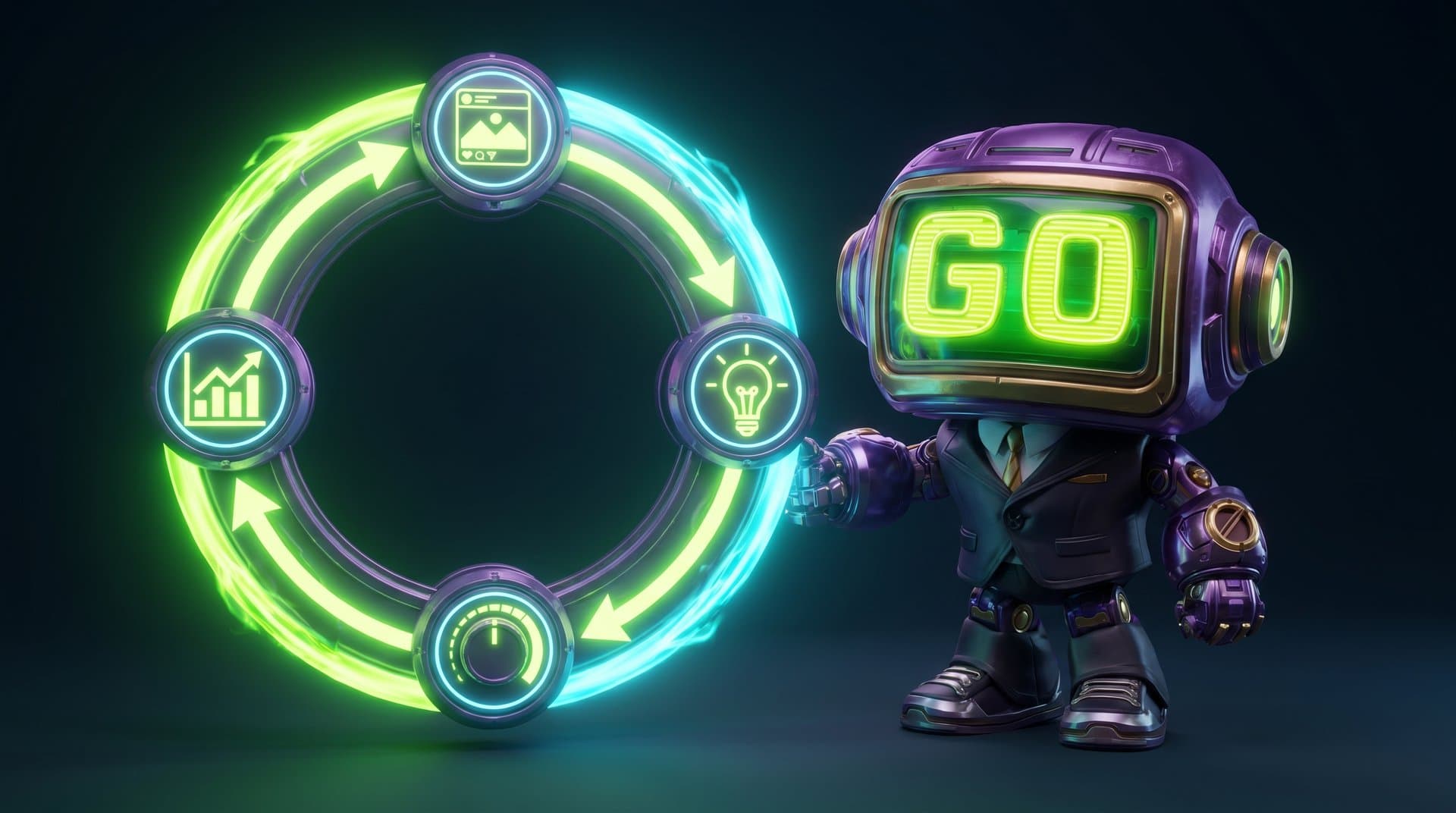
A self-improving system is a loop. The output of one cycle is an input to the next. The post goes out, the results come back, and those results change what the system does next time. Run the loop for a year and cycle 365 is genuinely smarter than cycle 1, because 364 cycles of evidence are now inside it. Same effort per cycle; completely different trajectory. Everything below is about closing the loop — turning the line into a ring.
The four moves of the loop
Each turn of the loop has four moves. Skip any one and the loop is broken — and a broken loop quietly degrades back into a line.
- Post — with a recorded intention. A post does not go out as just content. It goes out attached to a hypothesis: this topic, this format, this time, because we expect this. Without a recorded intention, the results that come back can't be judged — you can't grade an answer when nobody wrote down the question.
- Measure — against the intention, not against vanity. When results arrive, the system compares them to what the post was for. Not 'did it get likes' but 'did it do the thing we predicted.' Measuring against intention is what makes the measurement mean something.
- Learn — turn results into a durable lesson. A single result is noise. The learning move accumulates results into patterns: this audience engages with this format; this topic underperforms; this hour beats that hour. The lesson is small, durable, and written down — it is the loop's memory.
- Adjust — change the next cycle, concretely. The lesson has to change behavior or it wasn't learning. The strategist weights toward what worked; the scheduler shifts the timing model; the content agent drops the format that fell flat. The adjustment is the loop actually closing.
Timing is a model, not a chart
'Improve the timing' deserves its own note, because it's where the loop pays off most visibly. The generic advice — 'post at 9am and 5pm' — is a chart someone else's data drew. A self-improving loop doesn't use that chart. It builds a timing model for this specific audience, from this audience's measured behavior, and the loop keeps correcting it: every post is also a timing experiment, every result also updates when this audience is actually reachable. After enough cycles the system's sense of timing is not advice — it's evidence about your audience specifically.
The same is true of content. 'Improve the content' is not the content agent trying harder. It's the loop feeding the content agent a steadily sharper picture of what this audience responds to — which is the only definition of 'better content' that means anything.
“A content generator runs the same line forever. A self-improving loop runs a ring — post with an intention, measure against it, learn the pattern, adjust the next cycle. Same work each week, but one of them is a year smarter by December and the other is exactly where it started.”
Why this is the same engine, again
If this loop sounds familiar, it should — it's the same shape as the eval loop that improves the agents themselves, and the same shape as the consolidation a system does offline. Post-measure-learn-adjust is just how any system gets better at anything: act, observe the result against an intention, keep the lesson, change. A social-media agent system that runs this loop isn't doing something exotic. It's doing the one thing that separates a system that improves from a tool that merely repeats. More on how we build at gogogollc.com.