Who presses publish?
An agent system can draft a brand's posts, schedule them, even reply to comments. The question every business actually asks me before they buy one is quieter and more important: who presses publish? Designing the human seam in an autonomous social system is the difference between a tool you trust and one you don't.

Okan Özalan
Co-founder, GOGOGO LLC
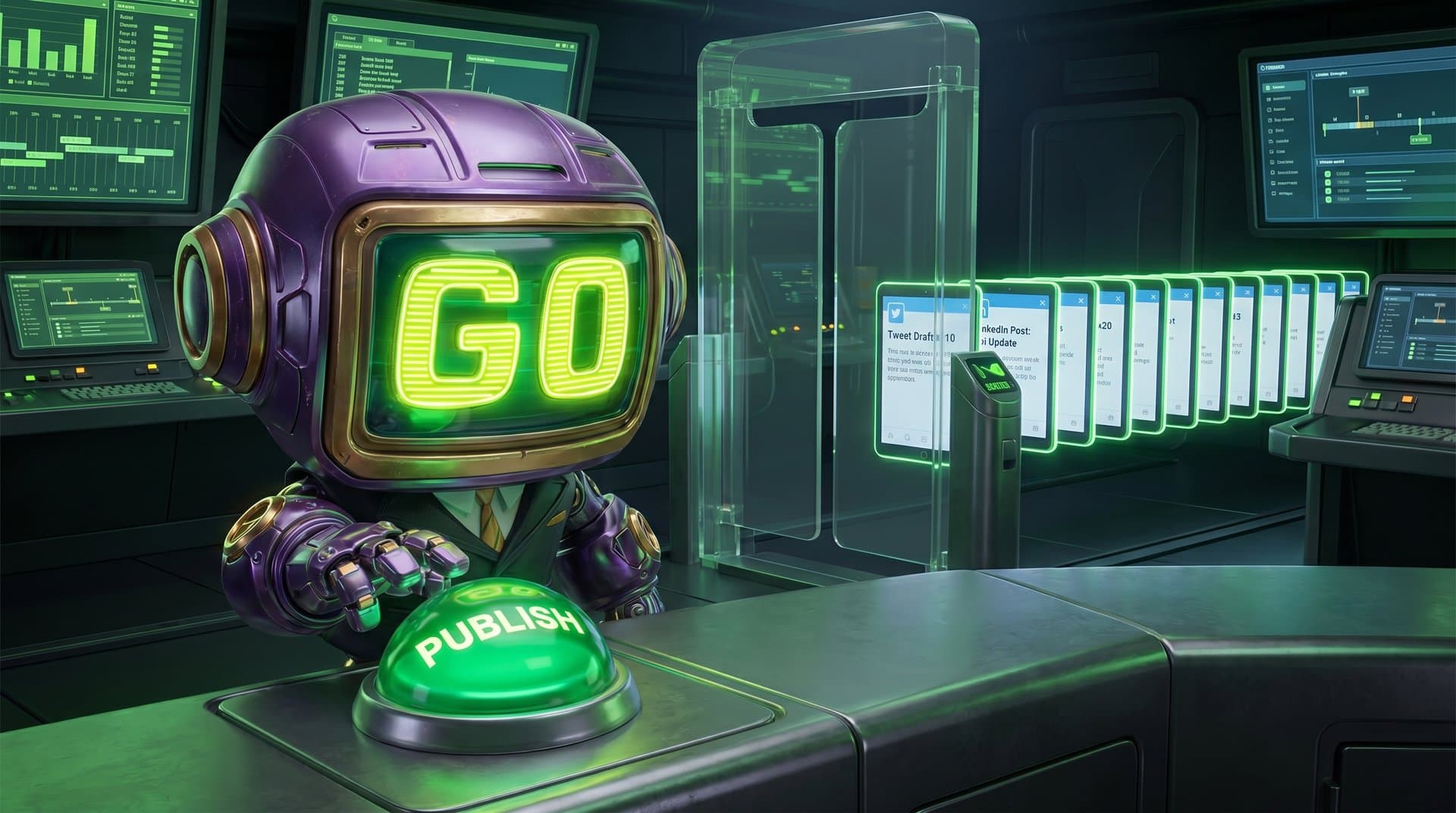
I'm Okan — I run the business side of GOGOGO LLC, which means I'm usually the one in the room when a company asks us to build an agent system for their social media. They ask about the content, the scheduling, the analytics. But the question that actually decides whether they buy is quieter, and it always comes: who presses publish?
It's the right question. A social-media agent system can draft posts, plan a calendar, and reply to comments. The moment something it produced becomes public, in the brand's name is the moment that matters — because that moment can't be taken back. This post is about designing that moment: the human seam in an autonomous social system.
The asymmetry that governs everything
Social media has an asymmetry that should drive the whole design. A good post is worth a little. A bad post — off-voice, ill-timed, tone-deaf about something happening in the world — can be worth a lot of damage, fast, and publicly. The upside of any single post is small and the downside is large and irreversible.
When the downside dwarfs the upside and can't be undone, you do not optimize for speed or full autonomy. You design for control at the dangerous step. This is the same instinct as the 3am-failure discipline: find the irreversible action and put a deliberate gate in front of it. For a social agent system, the irreversible action is publishing, and the gate is a human.
Three zones, not one switch
The mistake is treating autonomy as a single on/off switch for the whole system. It isn't one decision. A social-media agent system has different actions with wildly different stakes, and each belongs in a different zone.
Green — the agent acts alone
Work that is reversible and low-stakes: drafting, researching, preparing options, assembling the analytics, proposing a calendar. Here the agent should run freely with no human in the loop — gating this work would just be friction. Most of the system's actual hours live in the green zone, and that's where the time savings come from.
Yellow — the agent proposes, a human disposes
The publish decision itself. The agent does all the work up to the edge — the post is drafted, on-voice, scheduled, queued — and then it stops, and a human gives the yes. This sounds like it would be slow. It isn't, because the human isn't doing the work; they're doing the judgment, on finished work, in seconds. Reviewing a ready post is fast. The yellow zone is where trust is actually held.
Red — the agent must not act, and must escalate
Anything touching a crisis, a sensitive event, a complaint with legal or safety weight, an angry exchange escalating in public. Here the agent's correct move is to not act and raise its hand. A system that knows the boundary of its own competence — and stops at it loudly — is more trustworthy than one that's merely cautious everywhere.
Why the seam makes the system more valuable, not less
A business owner sometimes hears 'a human still presses publish' as the system being less finished — as if true success would be removing the human. I argue the opposite, and I believe it. The human seam is what makes the system deployable at all. A fully autonomous social system is one most brands correctly will not turn on, because the downside is unbounded — so its real-world value is zero. The same system with a clean publish gate is one a brand will run, because the catastrophic outcome is fenced off. A capability you can't safely switch on is worth nothing; the seam is what converts the capability into something usable.
“Publishing is irreversible and public, and a bad post costs far more than a good one earns. So the design question is never 'how autonomous can the social agent system be' — it's 'where does the human stand, and is that the one step that can't be undone.' Put the person on the publish button. Let the agents have everything else.”
What I tell people who ask
So when a company asks us for a social-media agent system and then asks, quietly, who presses publish — I tell them: you do, or someone you trust does, and the system is built to make that moment fast rather than to remove it. The agents draft, schedule, analyze, and propose — they will save your team most of the hours. The human keeps the publish decision, which takes seconds and holds all the risk. That division is not the system being incomplete. It is the system being designed by someone who understands what a brand has to lose. If that's the conversation your team is having, it's the one I like having too: info@gogogollc.com.