What playable ads taught me about agents.
A playable ad has about fifteen seconds to teach you a game, hook you, and convert you — with no instructions allowed. I've made a lot of them, and I love it. Those brutal constraints turn out to be the best training I ever got for designing how a person meets an AI agent for the first time.

Atakan Özalan
Co-founder & engineering lead, GOGOGO LLC
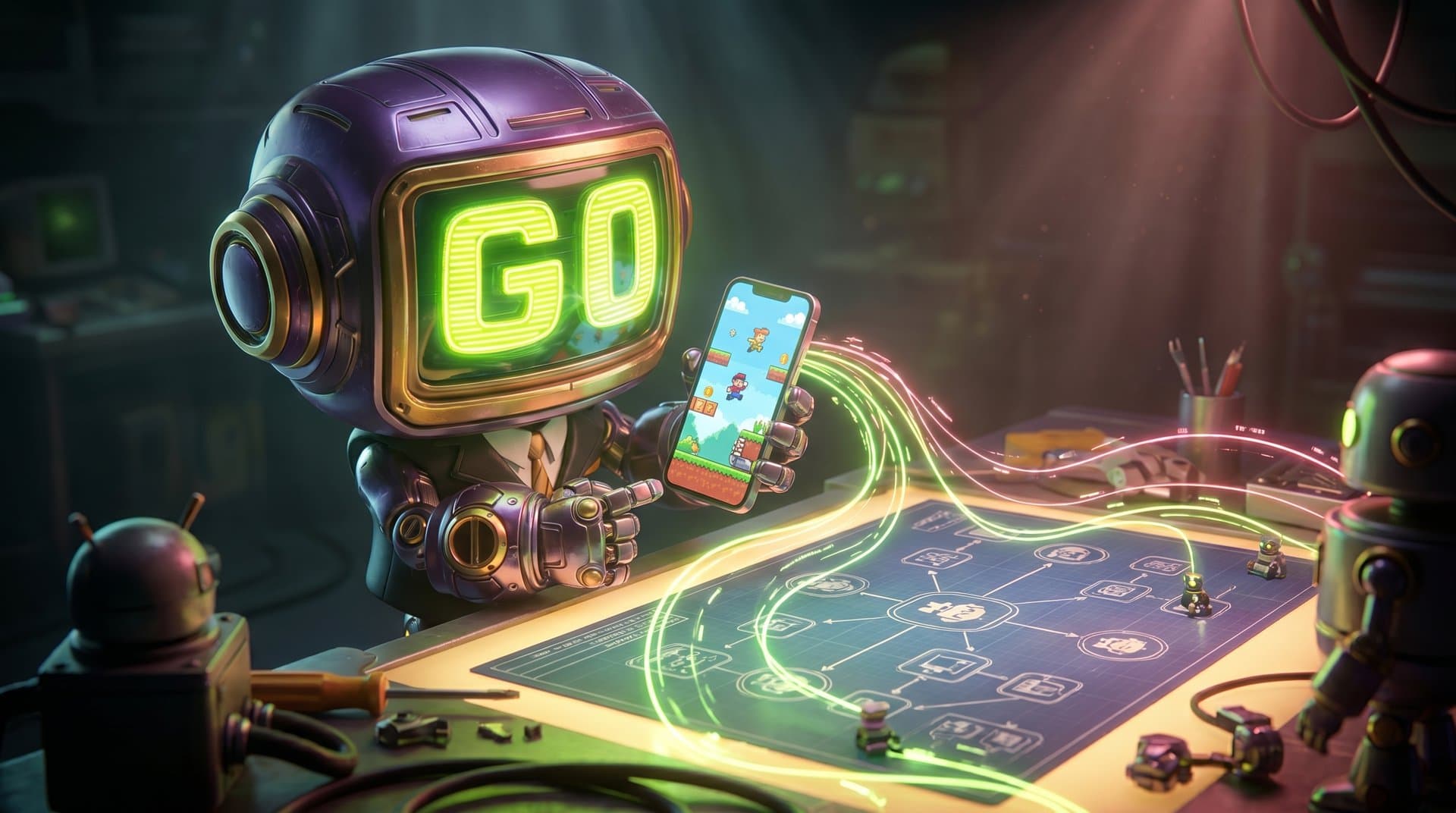
I make playable ads, and I genuinely love it. A playable ad is the little interactive mini-game that appears inside another app — you tap it, you're suddenly playing a tiny slice of some game, and a few seconds later it asks if you want to install the full thing. It is one of the most constrained design problems in software, and I find that constraint addictive.
Here's why I'm writing about it on an engineering blog for GOGOGO LLC. The discipline of the playable ad — what those fifteen seconds force you to learn — turned out to be the best preparation I ever had for a completely different problem: designing the moment a person first meets an AI agent. The constraints rhyme, and the lessons transfer almost exactly.
The constraint: fifteen seconds, no manual
A playable ad has roughly fifteen seconds. In that window it has to do three things, in order: teach you how to play, hook you so you want more, and convert you to the install. And it must do all of it with no instructions — nobody reads a tutorial inside an ad. If the player is confused for even three seconds, they're gone, and you paid for that impression.
Every constraint that makes a playable ad hard is a constraint you wish you had taken seriously when designing an agent product. AI products love to explain themselves — onboarding flows, tooltips, documentation, a manual. The playable ad doesn't get any of that. It has to be immediately legible. Working in that mode for years rewired how I think about first contact with any system.
Lesson 1 — the first three seconds are the whole game
In a playable ad, the first three seconds decide everything. Not the cleverest mechanic, not the reward — the first three seconds, where the player either understands what to do or doesn't. I learned to spend a wildly disproportionate amount of effort on those three seconds, because the other twelve don't exist if you lose them.
The first time a person uses an AI agent has the same shape. There is a three-second window where they either grasp what this thing is for or quietly decide it's not for them. Most agent products spend their effort on the impressive deep capability and almost none on the first three seconds. Playable ads taught me to invert that: make the opening instantly legible, then earn the right to show depth.
Lesson 2 — teach by letting them do, never by telling
A playable ad never says 'tap here to jump.' It builds a situation where the only possible action is the thing, and it lets a glowing hint point at it. The player learns the mechanic by performing it, in the first second, without realizing they were taught. I wrote about this same instinct from the game-tutorial angle — but the playable ad is that lesson under far more time pressure, and the pressure makes it sharper.
An agent's first interaction should work identically. Don't open with an explanation of the agent's architecture. Open with one obvious action that produces one real result. The user learns what the agent is by watching it do something, in the first interaction, the way a playable ad teaches a jump by needing one.
Lesson 3 — one mechanic, not the whole game
A real game has dozens of mechanics. A playable ad for that game shows one — the most representative, most graspable one — and ruthlessly cuts the rest. Trying to cram the whole game into fifteen seconds produces noise, and noise reads as confusion, and confusion is death. The skill is choosing the single mechanic that best represents the whole.
This is the lesson I see violated most in AI products. The instinct is to show everything the agent can do, because it's all impressive. A playable ad would never. It picks the one capability that best represents the system and leads with only that. The breadth is real, but breadth shown too early reads as confusion — the same way a playable ad that shows five mechanics reads as noise.
Lesson 4 — honesty converts better than hype
Early in making playable ads, I'd be tempted to make the ad flashier than the game — bigger explosions, faster action than the real thing delivers. Those ads convert worse, not better. The install happens, then the reality doesn't match, and the user churns within a day. The playable ads that convert and retain are the ones that show the real core loop honestly. The ad is a promise, and the product has to keep it.
Exactly the same is true of an agent demo. An over-promising demo wins the signature and loses the renewal. I'd rather a first interaction undersell slightly and let the agent over-deliver. Playable ads taught me that the honest version is also the higher-converting version, once you measure past the first day — and I find that quietly reassuring about the world.
“A playable ad gives you fifteen seconds, no manual, and one shot to make a stranger understand. Strip an AI product's onboarding down to those rules and it gets dramatically better — because the rules were never about ads. They were about respecting how little patience a first impression actually gets.”
Why I still make them
People sometimes ask why an engineer building multi-agent systems still makes playable ads. This is why. The playable ad is a fifteen-second gym for the single hardest skill in product design — making something instantly understood by someone who owes you no patience. Every playable ad I make sends me back to the agent work a little sharper about first contact. The format is tiny. The discipline is not. More of how I think at atakanozalan.com.