Anatomy of a playable ad.
A playable ad is a fifteen-second interactive mini-game built to sell another app. It looks simple and it is brutally engineered. Here's the teardown — the first three seconds, the hook, the core loop, the call-to-action — what each part does, how each part fails, and why this is the most disciplined format in advertising.

Atakan Özalan
Co-founder & engineering lead, GOGOGO LLC
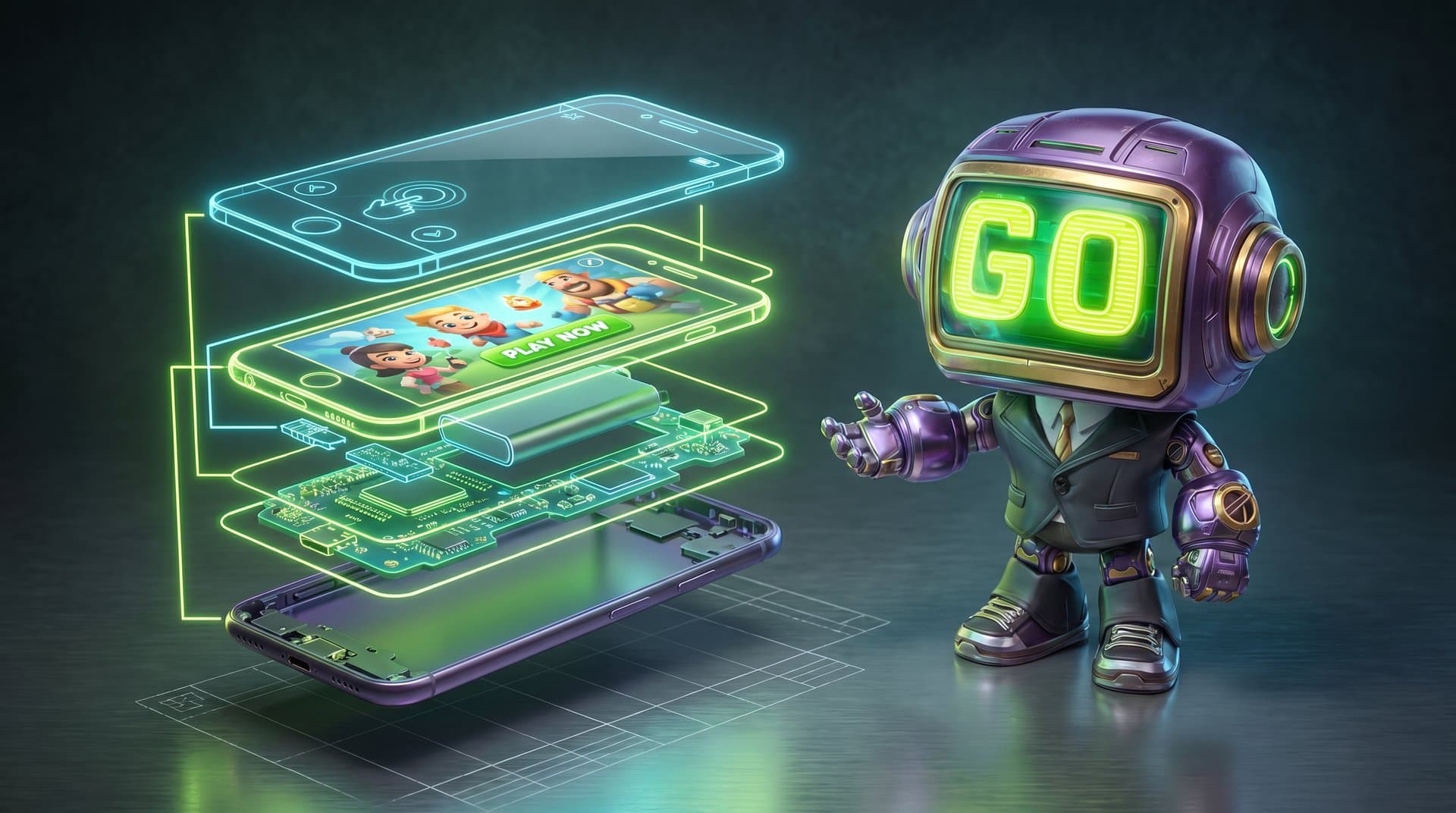
A playable ad is an advertisement you can play. Instead of watching a video about an app, you get dropped into a tiny interactive slice of it — a fifteen-second mini-game — and at the end it asks if you want to install the real thing. It is everywhere in mobile advertising, and most people tap through dozens without ever noticing how tightly engineered they are.
I make playable ads, and I want to take one apart on the bench. This is the anatomy: the four parts every playable ad has, what each one is for, and the specific way each one fails. If you build any product where a stranger has to understand something fast — and an AI product absolutely counts — the structure is worth knowing. We build agent systems at GOGOGO LLC, and this teardown is closer to that work than it looks.
Part 1 — the first three seconds (the legibility test)
Before the ad can hook anyone, it has to be understood. The first three seconds exist to answer one question in the player's head: 'what am I supposed to do?' A clear scene, one obvious target, usually a pointing hint. Nothing clever happens here — clever comes later. This part has exactly one job: make the next action obvious.
How it fails: ambiguity. Two things the player could tap, an unclear goal, a scene too busy to parse. A playable ad that fails the legibility test doesn't get a worse result — it gets no result, because the player is gone before part two. Most weak playable ads are not badly built; they're just illegible in the first three seconds.
Part 2 — the hook (the reason to continue)
Once the player knows what to do, the hook gives them a reason to want more. It's the first hit of the game's actual fun — a satisfying match, a near-miss, a small spectacular reward. The hook is an emotional promise: there is more of this feeling if you continue.
How it fails: arriving too late, or being a lie. A hook in second ten is a hook nobody reaches. And a hook that promises a feeling the real game doesn't deliver converts the install but loses the user within a day — the ad wrote a check the product couldn't cash. The hook has to be early and true.
Part 3 — the core loop (the honest sample)
The core loop is the few seconds where the player actually plays — does the real action, gets the real feedback, does it again. This is the honest sample of the product. A good playable ad makes the core loop the real core loop of the game, just concentrated. It is the part that decides whether a converted user stays converted.
How it fails: dishonesty, again — a core loop that's flashier or easier than the real game. The playable ad that shows the true loop converts fewer installs but keeps far more of them. Measured past day one, honest core loops win. Most teams optimize the loop for the install and quietly lose on retention.
Part 4 — the call to action (the single clear door)
The call to action is the end: install the app. The rule is one call to action, unmistakable, at the moment the player most wants more. Not three buttons, not a menu — one door, at peak desire. A CTA that arrives after the desire has cooled, or that offers a confusing set of choices, leaks most of the conversions the first three parts earned.
How it fails: bad timing or too many options. Peak desire is a narrow window — the CTA has to land inside it. And every extra choice at the CTA is a chance to hesitate, and hesitation is a lost install. One door, one moment.
“A playable ad looks like a toy and is built like an instrument: legibility, hook, honest loop, one clear door — in that order, each tuned, none skippable. The format is fifteen seconds long and there is nowhere to hide a mistake. That is exactly what makes it worth studying.”
Why the anatomy generalizes
Read those four parts again with an AI product in mind. The first run has to be legible in seconds. It needs an early hook — one real result that makes the user want more. It needs an honest core sample — the real capability, not a flashier mock. And it needs one clear next step, not a panel of options. The playable ad didn't invent these; it just runs them under so much time pressure that the structure becomes impossible to ignore. Learn the anatomy on the fifteen-second format, and you see it everywhere. More of how I think at atakanozalan.com.