Sixteen with a production machine.
I ran a fishing-net components business when I was sixteen. Lead sinkers, plastic floats, monofilament line — my own machines, my own customers, my own invoices. Twenty years later I run an AI company and I still think every bad month at GOGOGO is easier than that summer.
Okan Özalan
Co-founder, GOGOGO LLC
Almost nobody who starts an AI company started somewhere with a real machine on the floor. I did. I think it shows in how we run GOGOGO LLC, and I think it's worth writing about now that we're three years in.
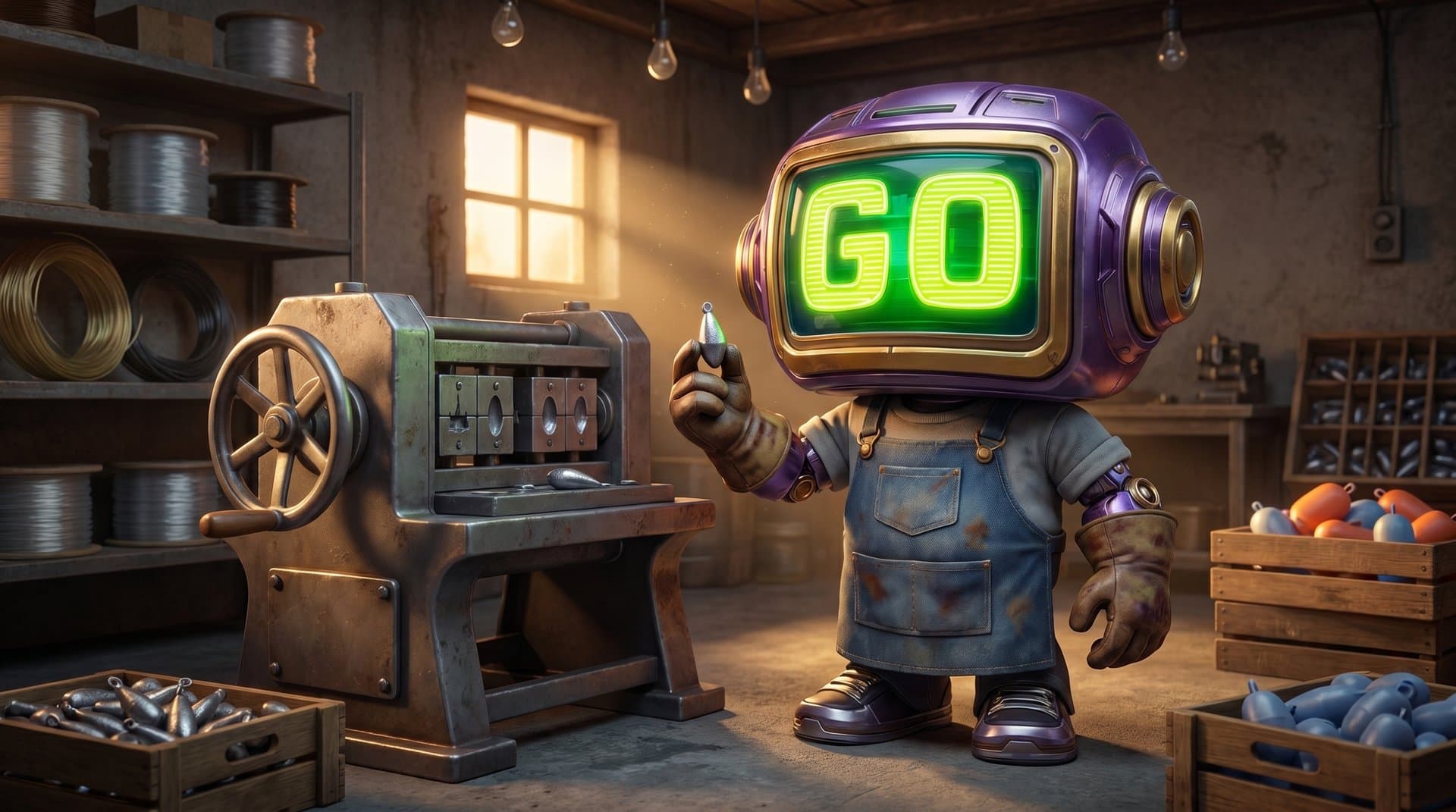
I was fourteen when I first started working — small jobs, the kind that teach you what an invoice looks like. At sixteen I bought my first lead-sinker production machine, a hand-crank piece of industrial metal that cast small lead weights for fishing nets. I added plastic-float moulds. I taught myself which suppliers extended credit and which ones didn't. By the end of that summer I was selling fishing-net components — sinkers, floats, monofilament line — to three coastal towns. I was a year too young for a driver's license. I was already running a business with margins, suppliers, and a debt I was responsible for.
What a production machine teaches you
A piece of physical equipment is a very honest teacher. It doesn't care about your business plan. It cares about three things: did you maintain it, did you feed it correctly, and did you find someone who wants to buy what it produces. If any of those three breaks, the machine stops and you don't get paid.
Every founder I meet who built an internet-only business as their first business has a slightly soft relationship with one of those three. Maintenance feels optional. Inputs feel infinite. Buyers feel like a downstream problem. They're not. Even now in 2026, even with AI products that deploy in twenty seconds, all three of those constraints are real. We just hide them behind better abstractions.
Three habits I kept
1. The cost of one unit is the only number that matters first
At sixteen I knew exactly what a single lead sinker cost me to produce — material, electricity, machine wear, packaging, transport to the coastal towns. Down to the cent. If I didn't know that number, I couldn't price. If I couldn't price, I couldn't sell. If I couldn't sell, the supplier didn't get paid and the machine got repossessed.
At GOGOGO I still operate this way. I want to know the cost of one customer call in our agent runtime. The cost of one Goddo render. The cost of one GoPeople routed message. Not the SaaS-wrapped margin, not the blended monthly bill — the unit cost. Atakan gives me those numbers because I keep asking. We've made architectural decisions because of those numbers.
2. The customer is closer than the product
Selling lead sinkers door-to-door to fishermen taught me something most enterprise sales decks never will. The customer is right there. He's holding a coffee. He's about to take his boat out. He doesn't care about my supplier negotiations. He cares about whether the sinker holds the right depth and whether I'll be back next week.
That's how I take every GoPeople customer call now. The director on the other side of the table is holding a coffee. She's about to go run her HR ops day. She doesn't care about our multi-agent runtime. She cares about whether her team can stop manually routing leave requests on WhatsApp.
3. The bad month is shorter than you think
The summer I turned seventeen, two things broke at once: my main supplier doubled his prices and my biggest buyer switched to a competitor I hadn't met. I lost most of my margin in three weeks. I was sixteen years old and on the hook for both the machine debt and a smaller debt I'd taken on to make the seasonal scale-up.
I didn't die. I made calls, I shifted product mix, I rebuilt the buyer pipeline by August. The lesson wasn't that I survived. The lesson was that the bad month is always shorter than the catastrophic story you tell yourself in week one. Now when GOGOGO has a bad month — a model release that lands wrong, a customer that cancels, a hire that doesn't work — Atakan tells me I'm the calmest person in the room. I'm not calm. I've just lived through worse, with worse margins, when I was sixteen.
From lead sinkers to natural stone to GOGOGO
The fishing-net business gave me operating discipline. The next one — a natural-stone home-decoration company I ran in my early twenties — gave me pricing discipline. (I'll write that one separately.) By the time my brother Atakan and I founded GOGOGO in 2023, I'd already spent fifteen years learning what a real business does on a Tuesday morning. The technology layer changed. The operating layer didn't.
People who only know me from GOGOGO assume I came in from the business-school track. I did go through Business Administration formally, yes. But the actual education was the production machine. The actual education was watching a supplier sigh on the phone and knowing what that sigh meant for the next two weeks.
“Software founders who only know software run softer companies than they think they do. The thing a physical-business background gives you is not magic — it's just a longer baseline of what 'normal hard' feels like.”
What this means for our products
Look at the products we ship — Goddo, GoPeople, GoVista — and the one our sister company GOTONOM A.Ş. ships, GoTrack, and you'll notice something. Most of them touch a physical operation. Store shelves watched by product cameras. HR teams routing WhatsApp messages with shift managers. Digital signage running on actual TVs. Only Goddo lives purely in software.
That's not an accident. We build for businesses that have a Tuesday morning. We build for the operator who's already on the phone with a supplier. We build for the manager who has to drive to a store to check the screen. The AI is a tool. The operation is the product. That's a lesson sixteen-year-old me taught forty-something-me, and I'm grateful for it every quarter.
If you want to talk operations, customer ops, or pricing, I'm easy to reach. okanozalan.com or okan@gogogollc.com.