RAG vs fine-tuning vs multi-agent: which does your problem need?
RAG, fine-tuning, and multi-agent systems solve three different problems, and most failed AI projects picked the wrong one. RAG gives a model knowledge. Fine-tuning gives it behavior. A multi-agent system gives it the ability to act over many steps. Here's a plain decision guide — what each one is, when to use it, and a decision tree.

Atakan Özalan
Co-founder & engineering lead, GOGOGO LLC
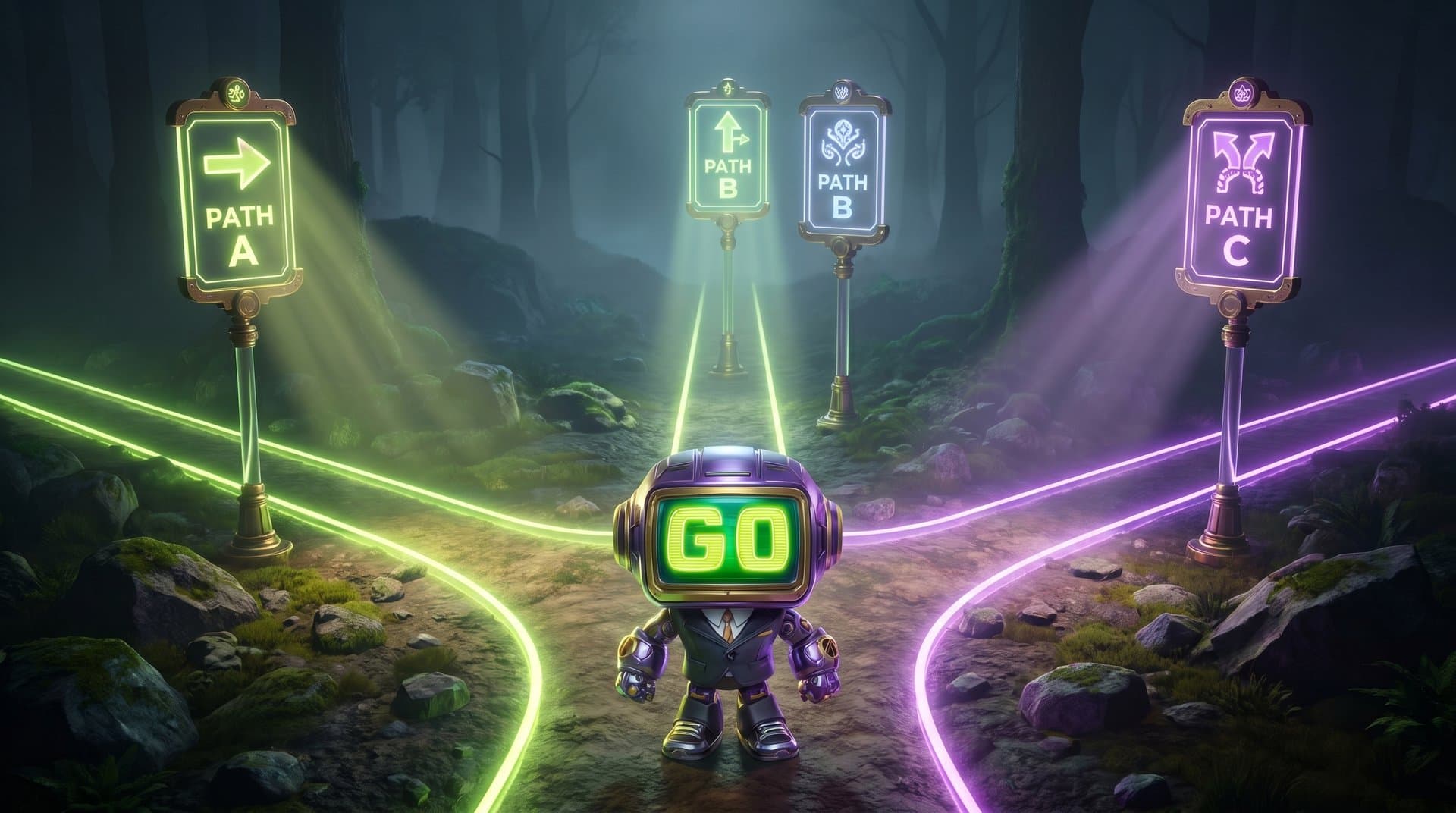
When a team decides to 'build something with AI,' the first real fork is technical: RAG, fine-tuning, or a multi-agent system? They get treated as competing answers to one question. They aren't. They answer three different questions, and the most common reason an AI project fails is that it picked the wrong one for the problem it actually had. This is a plain decision guide. We build all three at GOGOGO LLC, so the goal here is to help you not need all three.
RAG — when the model lacks knowledge
Retrieval-augmented generation (RAG) connects a model to a body of information it wasn't trained on — your documents, your policies, your product data. At answer time it retrieves the relevant pieces and puts them in front of the model, so the answer is grounded in your facts instead of the model's general training.
Use RAG when the problem is 'the model doesn't know my stuff.' The model is capable enough; it just lacks your specific, current facts. RAG's strengths: your knowledge can change daily and the system keeps up, and answers can cite their sources. Its limit: RAG changes what the model knows, not how it behaves — and it does not, by itself, let the system take actions.
Fine-tuning — when the model lacks a behavior
Fine-tuning continues training a model on examples until its default behavior shifts — a consistent tone, a strict output format, a specialized style or classification the base model doesn't reliably produce.
Use fine-tuning when the problem is 'the model doesn't act the way I need.' It knows enough; it just won't reliably behave the right way through prompting alone. Its strength: a durable behavior change baked into the model. Its limits: it's the heaviest to set up and maintain, it does not add fresh knowledge — a fine-tuned model is as stale as its training data — and, like RAG, it does not give the system the ability to act. A large share of teams reach for fine-tuning when their real problem was knowledge (use RAG) or careful prompting (use neither).
Multi-agent — when the work needs many steps
A multi-agent system coordinates several specialized agents — retrieving, generating, checking, orchestrating — to complete a task that takes multiple steps and tool calls. It's the only one of the three that is fundamentally about doing, not just answering.
Use multi-agent when the problem is 'this isn't one answer, it's a process.' The task has distinct sub-jobs, needs tools, runs over many steps, and benefits from each part being built and graded separately. Its strength: it handles real workflows, not just questions. Its cost: it's the most moving parts, so it demands real observability and evaluation. Don't build multi-agent for a problem a single grounded answer would solve.
The decision tree
Walk it in order. Stop at the first 'yes.'
- Is the task a single question with a single answer? → You may need none of the three. Try careful prompting first. It's free, and it's the answer more often than vendors admit.
- Is the problem that the model doesn't know your specific, current facts? → RAG.
- Does the model know enough, but consistently behave, format, or sound wrong despite good prompting? → Fine-tuning.
- Is it not one answer at all, but a multi-step process that needs tools and produces an outcome? → A multi-agent system — likely with RAG inside it.
“Most failed AI projects are not failures of intelligence. They are failures of diagnosis — a knowledge problem solved with fine-tuning, or a prompting problem solved by building agents. Name the problem correctly and the technique is almost obvious.”
How to choose well
Write down, in one sentence, what is actually wrong with the simplest possible version of your system. If the sentence is 'it doesn't know X,' that's RAG. If it's 'it won't behave like Y,' that's fine-tuning. If it's 'it can't do Z, because Z is a process,' that's multi-agent. The technique should fall out of the diagnosis — never the other way around. If you want a second opinion on which one your problem needs, that conversation is free: info@gogogollc.com.