Points, badges, leaderboards — for the agents, not the users.
Gamification's oldest triad — points, badges, leaderboards — is always pointed at users, to make them come back. We point it the other way. At GOGOGO the points, badges and leaderboards are for the agents: it's how a multi-agent system is scored, qualified, and improved. Gamify the machine, not the customer.

Atakan Özalan
Co-founder & engineering lead, GOGOGO LLC
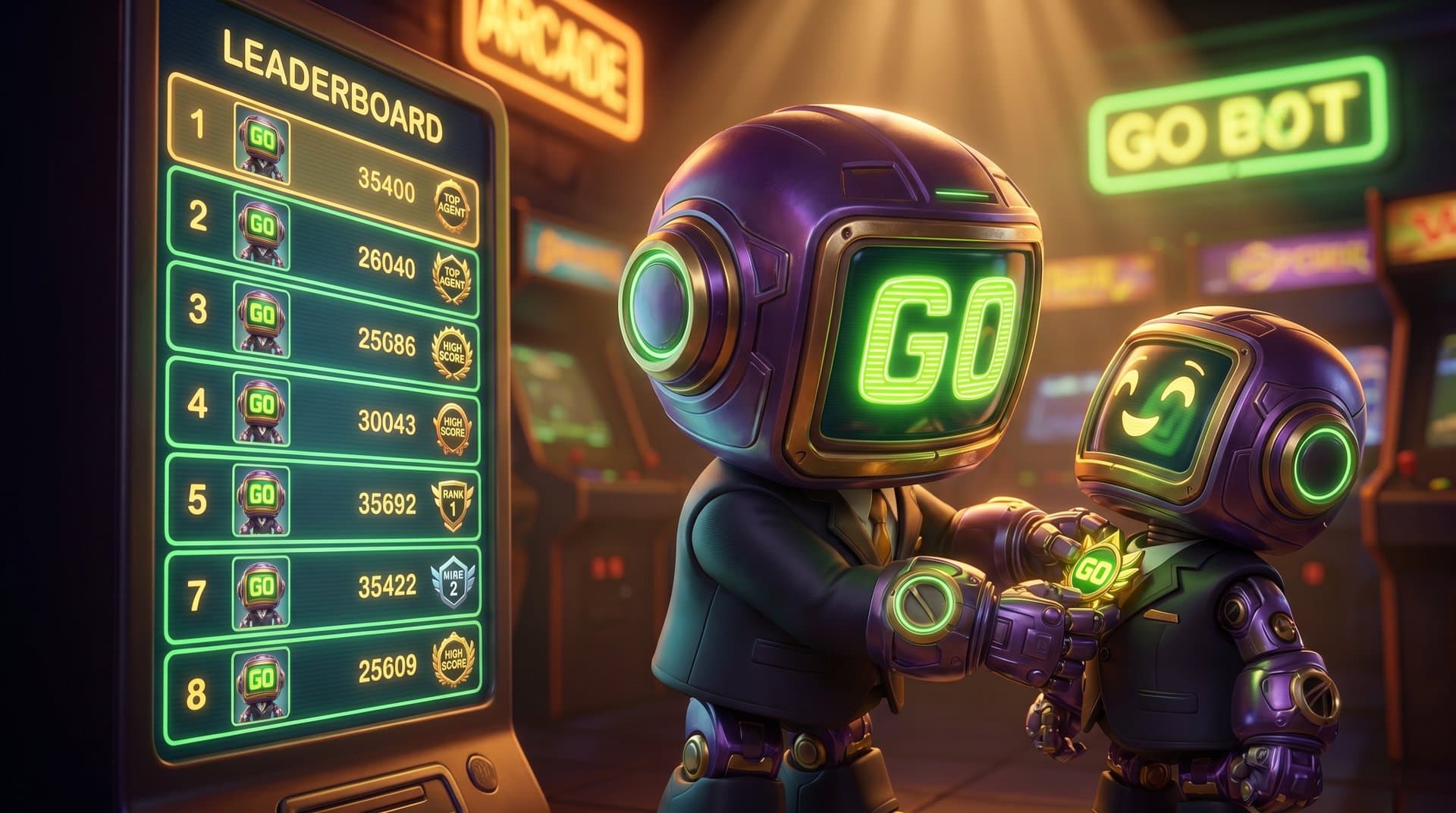
Gamification has a famous starter kit, known by its initials: PBL — points, badges, leaderboards. Add points to your app, hand out badges, post a leaderboard, and users will engage more. It's the first thing most people mean by 'gamification,' and it is almost always aimed at one target: the user, to make them come back more often.
At GOGOGO LLC we use PBL constantly — but pointed the other way. Our points, badges and leaderboards are not for the customer. They're for the agents. PBL, aimed inward at the machine, turns out to be a precise description of how you actually run a multi-agent system. This post is that flip, and why it's more than a cute metaphor.
Points — every agent run has a score
In user-facing gamification, points are a number that goes up when you do the desired thing. In our runtime, every agent run is scored — by the eval harness. Schema validity, grounding, no hallucination, replayability: each run gets graded, and the grade is a number attached to the run.
That number is the agent's points. And it does exactly what points do in a game: it makes an invisible thing — 'did this go well?' — visible and comparable. Before you score runs, agent quality is a vibe. After, it's a number you can watch move. The first act of gamifying the machine is the same as the first act of gamifying a user: make the score real.
Badges — capabilities an agent has earned
A badge, in a game, is a durable mark that you achieved something specific — distinct from points, which fluctuate. In our system, a badge is a capability an agent has earned the right to use. An agent isn't simply allowed to call an external tool, write to memory, or run unattended overnight. It earns each of those — by passing the eval set for that capability, repeatedly, with a high enough score.
This is gamification's badge logic used as a permission system. A new agent starts with almost no badges; it can draft but not send, suggest but not act. As it proves itself on the eval set, it earns badges, and each badge unlocks a capability. The badge is not decoration — it is the audit trail of why this agent is trusted to do this thing. 'Which badges does this agent hold' is a question with a real, safety-relevant answer.
Leaderboards — configurations compete, the best one ships
A leaderboard ranks players. Ours ranks agent configurations. When an engineer proposes a change — a new prompt, a swapped model, a re-tuned reranker — the new configuration is run against the frozen eval set and it gets a rank against the current one. The leaderboard is the eval scoreboard, and the rule is simple: the configuration at the top of the leaderboard is the configuration that ships.
This kills the worst dynamic in AI engineering — shipping a change because it felt better in a demo. On a leaderboard, feelings don't have a column. A change either climbs the board or it doesn't, and if it doesn't, it doesn't ship. The leaderboard makes 'is this better?' a settled question instead of an argument.
“Gamification, aimed at a user, asks: how do I make a person come back? Aimed at the machine, it asks: how do I make quality visible, capability earned, and improvement provable? Points, badges, leaderboards answer the second question even better than the first.”
Why the flip matters
There's an ethical reason I prefer PBL pointed inward, and it's not incidental. User-facing gamification has a dark history — points and streaks engineered to exploit, not to serve. We've all installed the app that gamified us into a corner. I have real reservations about aiming these mechanics at customers, and I'll write about that line separately. But pointed at the agents — at the system's own machinery — PBL has no victim. Scoring a run, gating a capability, ranking a configuration: the only thing being 'engaged' is the software. You get all of gamification's clarity and none of its capacity to manipulate a person.
So when someone asks whether GOGOGO 'uses gamification,' the honest answer is: constantly — just not on you. The points, badges and leaderboards run under the hood, on the agents, where game mechanics do what they're genuinely good at: turning a fuzzy system into a measured one. Gamify the machine. Leave the customer alone. More on how we build at gogogollc.com.