The hook model, applied to multi-agent AI.
Nir Eyal's hook model — trigger, action, variable reward, investment — was designed for habit-forming consumer apps. It maps almost too well onto how a multi-agent AI product earns customer retention. Four steps. Four examples from GOGOGO. Two warnings.

Atakan Özalan
Co-founder & engineering lead, GOGOGO LLC
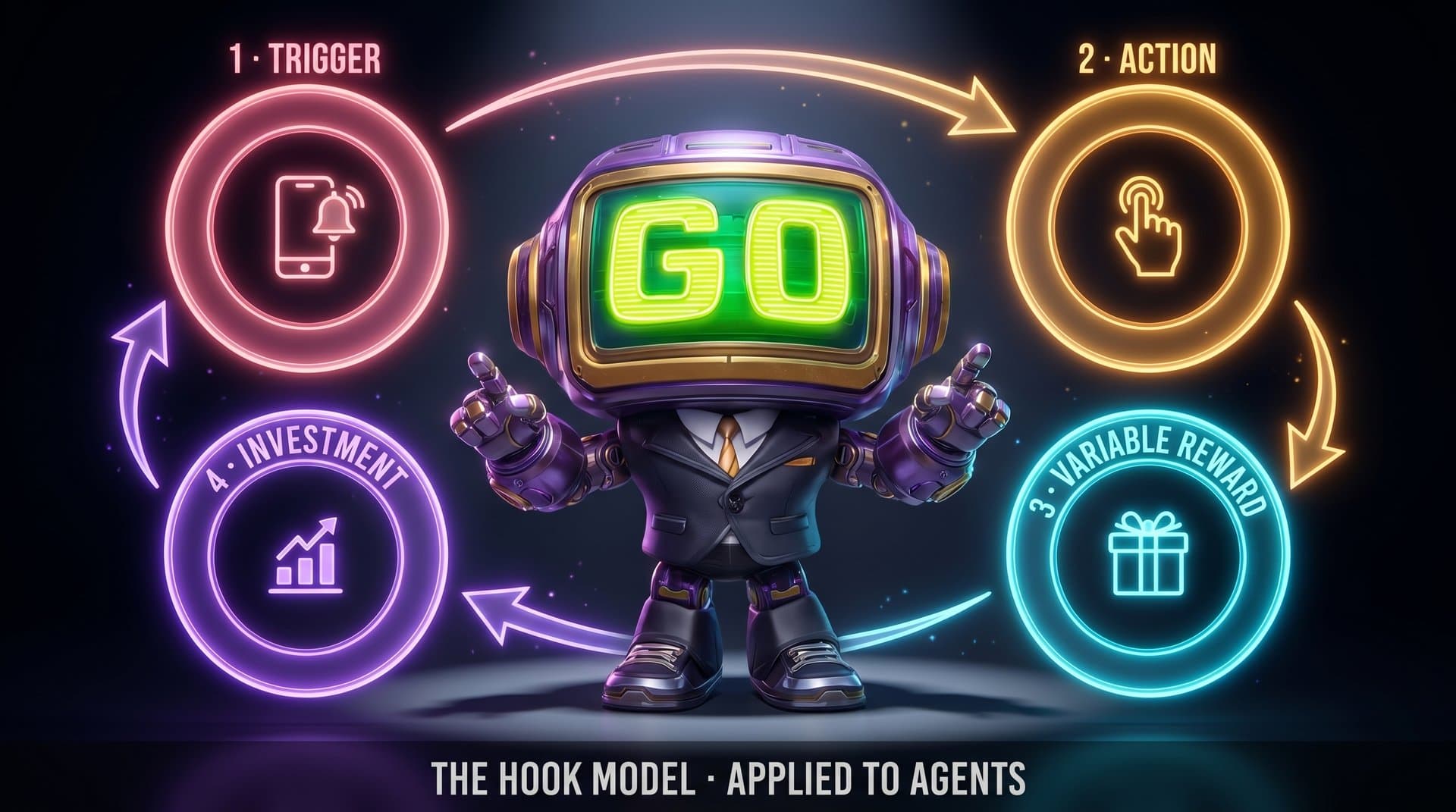
I've been talking about Nir Eyal's hook model since university. It showed up in nearly every presentation I gave back then — I'd sketch the four-step loop on a slide and argue that it explained more about software than most software-engineering frameworks did. Long before GOGOGO LLC existed, the hook model was already one of the lenses I thought through. Hooked is nominally about consumer-app habit loops — Instagram, Slack, TikTok. AI products weren't a category yet. But three years into building multi-agent systems, I think it's still the single most useful framework I've found for designing how a multi-agent product earns customer retention — and almost nobody in AI talks about it.
The four steps — trigger, action, variable reward, investment — apply with very little translation. Here's how I think about each one for our products.
1 · Trigger
External triggers are notifications, emails, calendar alerts. Internal triggers are feelings — boredom, anxiety, mild frustration with a current process. In consumer apps, the internal trigger is what eventually makes the user pick up the phone without being prompted.
In B2B AI, the internal trigger is the same: a recurring annoyance the user has stopped noticing they have. For GoPeople, it's the HR director's 7pm WhatsApp triage — the sigh when 47 unread messages need replies before tomorrow morning. For GoVista, it's the retail ops manager looking at a calendar of campaigns and feeling tired thinking about which screens still need updating. We build product entry points that map to those sighs. Onboarding a customer is mostly about teaching them to notice the sigh, then handing them a one-tap reply that resolves it.
2 · Action
Action is the smallest behaviour the user can take to relieve the trigger. The lower the friction, the more reliable the loop.
Most AI products fail this step badly. They demand login, configuration, prompt-engineering, model selection. The action is too heavy. Every step of friction multiplies the dropout rate by ~3×.
GoPeople's action is forward the WhatsApp message to the agent number. That's it. Zero clicks beyond a forward. The whole product is downstream of that one keystroke. Goddo is similar — tap, describe in one sentence, get four image variants. We don't ask the user to pick a model. We pick. They tap.
3 · Variable reward
Variable reward is the part of the loop that hooks the dopamine — something happens, and you can't quite predict what. Slot machines, social feeds, push notifications all use it. The unpredictability of the reward is what makes the loop addictive.
AI products have a natural variable reward built in: the output of an agent is non-deterministic. You ask Goddo for an image, you don't know exactly what you'll get. You forward GoPeople a message, you don't know exactly which workflow will run. Variability is structural to the medium.
This is the easiest step to get too right. If the variance is too high, the user loses trust and stops. If it's too low, the loop stops being a loop. The Goddo team tunes diffusion guidance scale partly for image quality and partly for productive surprise. Same dynamic.
4 · Investment
Investment is the small act of putting effort into the product that increases the next loop's value. Saving a contact. Liking a post. Importing a calendar. Each act makes the user more likely to come back, because they've now paid in a little.
GoPeople's investment loop: every reply the agent sends gets approved (or corrected) by the HR director. Each correction trains a finer classifier for that customer's team. Six weeks in, the agent's reply rate without correction is 92%. The director invested those 6 weeks. They are not switching to a competitor.
What this looks like as a sketch
Every customer relationship we have is a hook-model loop. Trigger (a recurring annoyance) → Action (one-keystroke entry) → Variable reward (a non-deterministic but useful agent output) → Investment (a small act that personalizes the next loop). Six months in, retention is no longer about how good the model is — it's about how many investment cycles the customer has paid in. The fourth cycle is the unlock.
“Most AI products are built like one-shot tools. The successful ones are built like habits. The hook model is the cheapest way to redesign your product as a habit without losing the technical substance.”
Two warnings
Warning 1 — don't ship dark patterns. The hook model is amoral as a framework; it works just as well for slot machines and social media. We don't apply variable reward to engagement minutes. We apply it to task outcomes the user wanted anyway. The user comes back because the agent gave them something they would have spent an hour doing manually — not because we gamed their dopamine response.
Warning 2 — investment ≠ vendor lock-in. Investment is good when the user is getting compounding value from the act. Investment is bad when the act traps them in your product against their will. We let GoPeople customers export their full classifier and message log on demand. They never use it, because the loop is working. But they could.
If you want to talk product loops, agent design, or how we structure the loops across Goddo, GoPeople and GoVista, I'm easy to reach. atakanozalan.com or ezagor for the handle.