Censydiam in production.
Eight emotional motivations on two crossed axes. The Censydiam framework was built for FMCG brand strategy, but it's the cleanest way I've found to explain which AI product fits which customer type. Here's the wheel, and where each of our four products lives on it.

Okan Özalan
Co-founder, GOGOGO LLC
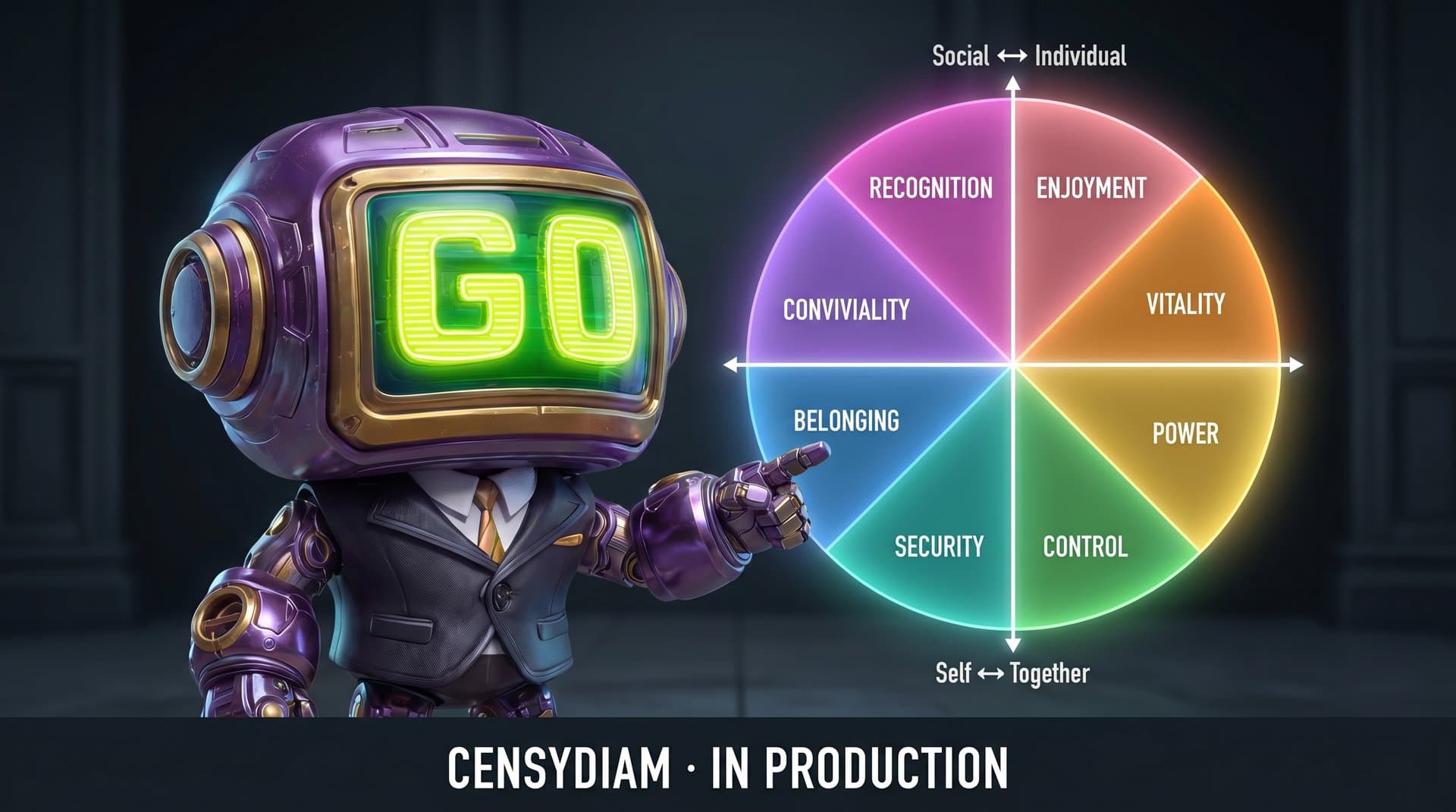
Censydiam is a consumer-motivation framework that came out of FMCG strategy in the 1990s. It maps human motivation onto a wheel: two crossed axes — social vs individual, and self vs together — produce eight emotional quadrants. Enjoyment. Vitality. Power. Control. Security. Belonging. Conviviality. Recognition. Every product or category occupies one or two quadrants more than the others.
I learned Censydiam during my corporate years, the Happiness Manager period. I didn't expect to use it for AI. But it turned out to be the cleanest model I had for explaining which kind of customer buys which of our four products. Here's the breakdown.
The wheel, quickly
Picture two crossed axes on a circle. The vertical axis runs social (top) to individual (bottom). The horizontal axis runs self (right) to together (left). The eight quadrants from the top-right going clockwise:
- Enjoyment (top-right, social/self) — pleasure, sensory delight, indulgence.
- Vitality (right, individual/self) — energy, novelty, exploration.
- Power (bottom-right, individual/self) — status, achievement, distinction.
- Control (bottom, individual/self) — mastery, certainty, structure.
- Security (bottom-left, individual/together) — safety, dependability, low-risk.
- Belonging (left, social/together) — connection, tradition, family.
- Conviviality (top-left, social/together) — warmth, shared good times.
- Recognition (top, social/together) — being seen, status from others, applause.
FMCG brands sit in one or two quadrants. Coca-Cola → conviviality + enjoyment. Volvo → security + control. Red Bull → vitality + power. Rolex → recognition + power. Once you see it, every consumer purchase fits.
Mapping the four GOGOGO products
Goddo — Enjoyment + Vitality
Goddo sells pleasure and novelty. The customer is a marketing lead or content creator who wants surprising, beautiful imagery. The dopamine is in the variability of each render. We sell variants, not certainty. Our pricing page leans into delight. Our share previews are colorful. The product is closer to a Spotify playlist than to a Photoshop replacement.
GoPeople — Security + Control
GoPeople sells certainty and mastery. The customer is an HR director whose worst day is missing a leave request that turned into a payroll mistake. The dopamine is in predictability — replies always look the same, classifications never drift, audit logs are always accessible. We sell consistency, not surprise. Our pricing page leans into trust signals. Our share previews use calm greens. The product is closer to a filing cabinet than to a creative tool.
GoVista — Recognition + Power
GoVista sells applause and status. The customer is a retail operations director whose campaigns need to look right across 300 stores — the visible side of brand. The dopamine is in the consistency of brand expression. We sell pixel-perfect signage at scale. Our pricing page leans into prestige customers. Our share previews show flagship-store screens. The product is closer to a luxury watch than to a CMS.
GoTrack — Control + Power
GoTrack sells mastery and distinction. The customer is a category manager who finally has data nobody else's stores have — what got picked up, when, by whom. The dopamine is in information asymmetry. We sell market-research-grade data in real time. Our pricing page leans into analytics depth. Our share previews show heat maps. The product is closer to a Bloomberg terminal than to a security camera.
Why this matters for messaging
Most AI startups talk about themselves the same way regardless of which product they're pitching. They lean on the same words — fast, smart, automated, intelligent — for every audience. It works for nobody.
Once you've mapped your product to its Censydiam quadrants, the messaging writes itself. For Goddo we say delight, variants, surprise. For GoPeople we say consistency, audit trail, no missed messages. For GoVista we say flagship-grade, brand-consistent, every screen synced. For GoTrack we say exclusive data, category leadership, what your competitors don't see. Same company, four messaging registers, each one cleanly matched to the buyer's actual emotional need.
“Censydiam doesn't tell you what to build. It tells you which words to use once you've built it. For an AI startup selling to four different buyer profiles across four products, that's the difference between a coherent positioning and four products fighting for the same generic vocabulary.”
Where this leaves us
Every quarter I open the Censydiam wheel and re-check our four product narratives against the quadrants we mapped them to. If a product is drifting — if Goddo's marketing starts leaning into certainty and control instead of delight and vitality — that's a signal we've lost the buyer thread and need to reset.
If you sell across multiple buyer profiles and want to compare notes on how to keep the messaging distinct, I'm easy to find. okanozalan.com or okan@gogogollc.com.