The sector map: where autonomous agents land next.
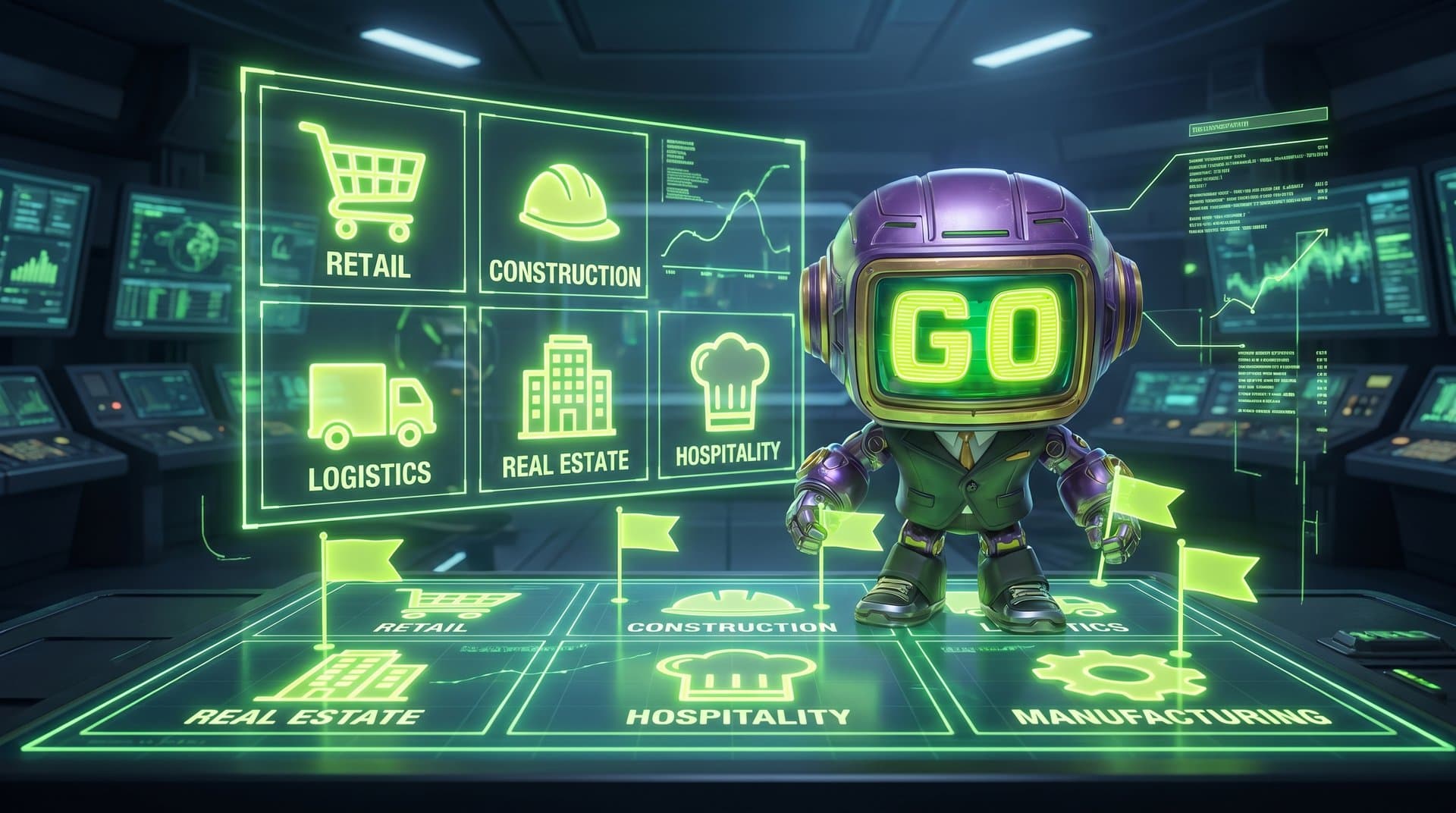
Every industry is being told that autonomous AI agents are coming for it. That's true — but not at the same time, and not for the same reasons. I sell agent systems to non-AI businesses for a living. Here's my honest sector-by-sector map: which industries are ready for autonomous agents right now, which are a year out, and the one signal that decides it.

Okan Özalan
Co-founder, GOGOGO LLC
I'm Okan — I run operations and the business side of GOGOGO LLC, and my actual day job is selling agent systems to people who do not work in AI. Retail managers. HR directors. Logistics operators. Restaurant groups. I've had the 'should we use autonomous agents' conversation with a lot of industries, and I want to write down what I've learned, because the public conversation is bad. Every sector is being told the same thing — agents are coming for you, now — and that's lazy. They are coming for every sector, yes. But not at the same time, and the reasons differ. This is my honest map.
First, the one signal that decides everything, because the whole map runs on it.
The readiness signal: bounded, repetitive, judged work
A sector is ready for autonomous agents when it has a lot of work that is bounded (the task has a clear start and end), repetitive (it happens many times a day, the same shape), and judged (there's a clear way to tell a good result from a bad one). When all three are true, an agent can do the work and you can grade whether it did it well. When any one is missing, autonomy is premature — you get a system nobody can trust and nobody can correct.
I learned this signal before AI, honestly. Before GOGOGO I built a real-world business with my brother — natural-stone home decoration — and earlier than that I ran a fishing-tackle production operation as a teenager. Every business I've ever touched has a layer of bounded, repetitive, judged work, and a layer of work that is none of those things. The map below is just that distinction, applied sector by sector.
Ready now
Retail operations. This is the most ready sector I deal with, and it's why GoVista exists. Updating in-store signage, scheduling promotions across locations, keeping screen content in sync — bounded, endlessly repetitive, and the result is visibly right or wrong. An agent owns this comfortably today. A retail manager gets hours back per week and never has to wonder if store #14 still shows last month's campaign.
HR and internal coordination. Triage, routing, answering the same policy questions, chasing the same approvals. GoPeople lives here. An HR director's WhatsApp at 7pm is forty-seven messages, most of which are five recurring questions wearing different clothes. That's bounded, repetitive, judged work — an agent absorbs it now, and the director gets to do the actual human part of HR.
Logistics and physical tracking. Counting, matching, logging what came in and what went out. GoTrack, made by our sister company GOTONOM A.Ş., applies it to the store shelf: its cameras log which product and colour is picked up, how long it is held and whether it goes back. It is the cleanest case of all — the work is fully bounded, relentlessly repetitive, and a count is objectively right or wrong. If your sector has a counting problem, you are ready today, full stop.
Roughly a year out
Hospitality and food service. Lots of bounded, repetitive work — reservations, supplier orders, shift coverage, the same guest questions. The reason it's not quite 'now' is the judged part: 'a good guest experience' is harder to score than 'the right count.' The pieces are arriving. Agents handle the back-office layer well today; the guest-facing layer needs another year of better evaluation before I'd hand it over.
Manufacturing and trades coordination. Scheduling, supplier follow-ups, compliance paperwork, quoting. From my natural-stone years I know this work intimately — it's extremely repetitive, but it's tangled with physical reality and with relationships, and the data lives in people's heads and phones. The work is ready; the data isn't yet. Once a sector digitizes its routine records, it jumps a tier. That's the bottleneck here, and it's closing.
Real estate and property operations. Listings, scheduling, tenant requests, document flow — bounded and repetitive. The blocker is that each transaction is high-stakes enough that the judged threshold is strict. Agents are already strong in the coordination layer; the closer you get to the money and the contract, the more a human stays on top. A year of trust-building moves most of this over.
Two years and a hard truth
Anything dominated by unbounded, relationship-heavy, high-consequence judgment. Senior negotiation. Creative direction. Crisis decisions. Care work where the human relationship is the product. These sectors are not 'behind' — they're genuinely different. The work fails the bounded test and often the judged test, and pretending otherwise is how you sell someone a system that quietly hurts their business. I won't do it.
And here's the hard truth I tell every buyer: almost no sector is autonomous-agent-ready as a whole. Specific workflows are. The honest unit of analysis is never 'the retail industry' or 'the HR industry' — it's a single workflow inside it. Every sector I listed has 'ready now' workflows and 'two years out' workflows sitting side by side in the same building. The company that wins isn't the one that 'adopts AI.' It's the one that correctly sorts its own work into those tiers and hands over the ready layer first.
“Autonomous agents aren't coming for industries. They're coming for workflows — the bounded, repetitive, judged ones — and every industry has a pile of those and a pile of the opposite. The skill isn't adopting AI. It's sorting your own work honestly.”
How to use this map
Don't ask 'is my sector ready?' Ask, for each recurring task in your week: is it bounded, is it repetitive, can I score it? Make two lists. The first list — hand it to agents now; that's where GOGOGO starts every engagement, with the workflow that scores highest on all three. The second list — keep it human, and revisit in a year as evaluation and your own data get better. That's the whole method. No sector is too early; plenty of workflows are. Want help drawing your two lists? That conversation is free — info@gogogollc.com.